Albert Bandura: Difference between revisions
CSV import |
CSV import |
||
| Line 39: | Line 39: | ||
[[Category:American psychologists]] | [[Category:American psychologists]] | ||
[[Category:Stanford University faculty]] | [[Category:Stanford University faculty]] | ||
<gallery> | |||
File:Albert_Bandura_Psychologist.jpg|Albert Bandura | |||
File:Sonny_Fox,_Bill_Ryerson_and_Albert_Bandura_speaking_at_a_Stanford_Conference_in_2018.jpg|Albert Bandura speaking at a Stanford Conference in 2018 | |||
</gallery> | |||
Latest revision as of 02:16, 18 February 2025
Canadian-American psychologist
Albert Bandura (December 4, 1925 – July 26, 2021) was a Canadian-American psychologist who was the David Starr Jordan Professor Emeritus of Social Science in Psychology at Stanford University. He is known as the originator of social learning theory (renamed the social cognitive theory) and the theoretical construct of self-efficacy. Bandura is also responsible for the influential 1961 Bobo doll experiment.
Early life and education[edit]
Albert Bandura was born in Mundare, Alberta, Canada, into a family of Polish and Ukrainian descent. He was the youngest of six children. Bandura attended the University of British Columbia, where he received his bachelor's degree in psychology in 1949. He then went on to the University of Iowa, where he earned his master's degree in 1951 and his Ph.D. in clinical psychology in 1952.
Career[edit]
After completing his doctorate, Bandura began teaching at Stanford University in 1953, where he remained for the rest of his career. His early work focused on aggression and the role of modeling in human behavior. This led to the development of his social learning theory, which emphasizes the importance of observing and modeling the behaviors, attitudes, and emotional reactions of others.
Social learning theory[edit]
Bandura's social learning theory posits that people learn from one another, via observation, imitation, and modeling. The theory has often been called a bridge between behaviorist and cognitive learning theories because it encompasses attention, memory, and motivation. Bandura's theory emphasizes the importance of observing and modeling the behaviors, attitudes, and emotional reactions of others.
Self-efficacy[edit]
In 1977, Bandura introduced the concept of self-efficacy, which refers to an individual's belief in their capacity to execute behaviors necessary to produce specific performance attainments. Self-efficacy affects every area of human endeavor. By determining the beliefs a person holds regarding their power to affect situations, self-efficacy strongly influences both the power a person actually has to face challenges competently and the choices a person is most likely to make.
Bobo doll experiment[edit]
The Bobo doll experiment was a study conducted by Bandura in 1961 to investigate if social behaviors (i.e., aggression) can be acquired by observation and imitation. The experiment involved children observing an adult model behaving aggressively towards a Bobo doll, and then being placed in a room with the doll to see if they would imitate the aggressive behavior. The results showed that children exposed to the aggressive model were more likely to act aggressively towards the doll, supporting Bandura's social learning theory.
Later life and legacy[edit]
Bandura continued to work and publish extensively throughout his career. He received numerous awards and honors for his contributions to psychology, including the American Psychological Association's Award for Distinguished Scientific Contributions. Bandura's work has had a profound impact on psychology, education, and beyond, influencing fields such as cognitive-behavioral therapy and education.
Related pages[edit]
Gallery[edit]
-
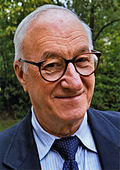 Albert Bandura
 -
 Bandura speaking at a Stanford Conference in 2018


-
Albert Bandura
-
Albert Bandura speaking at a Stanford Conference in 2018
