Dolichocephaly: Difference between revisions
CSV import |
CSV import |
||
| Line 28: | Line 28: | ||
{{stub}} | {{stub}} | ||
{{dictionary-stub1}} | {{dictionary-stub1}} | ||
<gallery> | |||
File:Dolichocéphalie_a_10_ans.jpg|Dolichocephaly | |||
File:Dolichocephalic_Lurcher_head.jpg|Dolichocephalic Lurcher head | |||
</gallery> | |||
Revision as of 02:13, 18 February 2025
Dolichocephaly is a condition where the head is longer than would be expected, relative to its width. In humans, this cranial shape is seen in individuals with certain genetic disorders, such as Sotos syndrome and Marfan syndrome, or as a result of premature fusion of the skull bones.
Causes
Dolichocephaly can be caused by a variety of factors, including genetic disorders and environmental influences. Some of the most common causes include:
- Sotos syndrome: This is a genetic disorder characterized by excessive physical growth during the first few years of life. Dolichocephaly is one of the common physical characteristics of this syndrome.
- Marfan syndrome: This is a genetic disorder that affects the body's connective tissue. People with Marfan syndrome often have a long, narrow face and skull, which can result in dolichocephaly.
- Premature fusion of the skull bones: The skull is made up of several bones that are separated by sutures. If these sutures close too early, it can result in a long, narrow head shape.
Symptoms
The primary symptom of dolichocephaly is a head that is longer than it is wide. Other symptoms can vary depending on the underlying cause of the condition. For example, individuals with Sotos syndrome may also have overgrowth in childhood, learning disabilities, and distinctive facial features. Those with Marfan syndrome may also have features such as a tall and slender build, heart defects, and eye problems.
Diagnosis
Diagnosis of dolichocephaly typically involves a physical examination and medical history. Imaging tests, such as X-rays or CT scans, may be used to confirm the diagnosis and assess the severity of the condition. Genetic testing may also be performed if a genetic disorder is suspected.
Treatment
Treatment for dolichocephaly depends on the underlying cause of the condition. In some cases, no treatment may be necessary. If the condition is caused by premature fusion of the skull bones, surgery may be required to correct the shape of the head. For individuals with genetic disorders, treatment may also involve managing other symptoms of the disorder.
See also
 | |
|---|---|
 |
 |
| This medical article is a stub. You can help Wikipedia by adding missing information. |
-
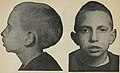 Dolichocephaly
 -
 Dolichocephalic Lurcher head


