Hitsumabushi: Difference between revisions
CSV import Tags: mobile edit mobile web edit |
CSV import |
||
| Line 21: | Line 21: | ||
{{Japanese cuisine-stub}} | {{Japanese cuisine-stub}} | ||
{{food-stub}} | {{food-stub}} | ||
<gallery> | |||
File:Hitsumabushi1.jpg|Hitsumabushi | |||
File:Hitsumabushi_1.jpg|Hitsumabushi | |||
File:CdazziHitsumabushi1.jpg|Hitsumabushi | |||
</gallery> | |||
Latest revision as of 02:04, 18 February 2025
Hitsumabushi is a popular Japanese dish, specifically a type of unagi (eel) dish, originating from Nagoya, a city located in the Chūbu region of Japan.
Overview[edit]
Hitsumabushi is a grilled eel dish, served over rice, and is considered a specialty of Nagoya. The eel is typically grilled over charcoal, and is basted with a sweet-soy reduction known as kabayaki sauce. The dish is served in a large wooden bowl, and is typically eaten in three stages, each offering a unique way to enjoy the dish.
Eating Method[edit]
The first stage involves eating the dish as is, savoring the flavors of the grilled eel and the kabayaki sauce. The second stage involves adding various condiments such as wasabi, green onions, and nori (seaweed). The third and final stage involves adding a flavorful broth to the remaining portion, transforming the dish into a sort of eel soup.
Cultural Significance[edit]
Hitsumabushi is more than just a dish in Nagoya; it is a cultural icon and a source of local pride. It is often served during special occasions and is a popular choice among tourists visiting the city. The unique three-stage eating method is also a part of the experience, adding a ritualistic element to the meal.
See Also[edit]

This article is a Japanese cuisine stub. You can help WikiMD by expanding it!

-
 Hitsumabushi
 -
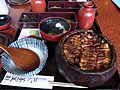 Hitsumabushi
 -
 Hitsumabushi


