Orthofluorofentanyl: Difference between revisions
CSV import |
CSV import |
||
| Line 29: | Line 29: | ||
{{pharmacology-stub}} | {{pharmacology-stub}} | ||
== Orthofluorofentanyl == | |||
<gallery> | |||
File:Orthofluorofentanyl_Structure.svg|Chemical structure of Orthofluorofentanyl | |||
File:O-fluorofentanyl.png|Orthofluorofentanyl | |||
</gallery> | |||
Latest revision as of 01:54, 18 February 2025
Orthofluorofentanyl is a potent synthetic opioid that is an analog of fentanyl. It is part of the fentanyl analogues family, which are known for their high potency and potential for abuse and overdose.
Chemistry[edit]
Orthofluorofentanyl, also known as 2-fluorofentanyl, is a fluorinated analog of fentanyl. It has the chemical formula C22H28FNO. Like other fentanyl analogues, it is a potent opioid receptor agonist.
Pharmacology[edit]
Orthofluorofentanyl acts primarily on the mu-opioid receptor, which is responsible for the drug's analgesic effects. It also has activity at the kappa-opioid receptor and delta-opioid receptor, which may contribute to its psychoactive effects.
The potency of orthofluorofentanyl is similar to that of fentanyl, making it a highly potent opioid. However, due to its high potency and lack of medical use, it is often associated with a high risk of overdose and death.
Effects[edit]
The effects of orthofluorofentanyl are similar to those of other opioids and include analgesia, sedation, euphoria, and respiratory depression. Due to its high potency, it also carries a high risk of overdose, which can result in death.
Legal Status[edit]
Orthofluorofentanyl is a controlled substance in many countries due to its high potential for abuse and the public health risks associated with its use. In the United States, it is a Schedule I controlled substance under the Controlled Substances Act.
See Also[edit]
References[edit]
<references />

Orthofluorofentanyl[edit]
-
 Chemical structure of Orthofluorofentanyl
 -
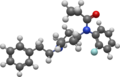 Orthofluorofentanyl


