Iyokan: Difference between revisions
CSV import |
CSV import |
||
| Line 26: | Line 26: | ||
{{Japan-cuisine-stub}} | {{Japan-cuisine-stub}} | ||
{{fruit-stub}} | {{fruit-stub}} | ||
<gallery> | |||
File:Iyokan_on_tree.jpg|Iyokan on tree | |||
File:Iyokan_for_sake_in_Kanagawa_Japan_-_2024_Feb_21.jpeg|Iyokan for sake in Kanagawa, Japan | |||
</gallery> | |||
Latest revision as of 01:35, 18 February 2025
Iyokan (Citrus iyo) is a type of citrus fruit that is primarily grown in Japan. It is the second most widely cultivated citrus fruit in Japan, after the Satsuma mandarin. The Iyokan is known for its unique flavor, which is a blend of sweet and sour, and its high vitamin C content.
History[edit]
The Iyokan was first discovered in the late 19th century in Ehime Prefecture, which is located on the island of Shikoku in Japan. The fruit is named after the old name of Ehime Prefecture, Iyo. Today, Ehime Prefecture remains the primary region for Iyokan cultivation, and the fruit is a significant part of the local economy.
Characteristics[edit]
The Iyokan is a medium-sized citrus fruit, slightly larger than a mandarin orange. It has a thick, rough skin that is a deep orange color. The flesh of the fruit is also orange, and it is known for being juicy and slightly tart. The Iyokan is typically eaten fresh, but it can also be used in cooking or to make marmalade.
Cultivation[edit]
Iyokan trees are evergreen and can grow up to 6 meters in height. They prefer a subtropical climate, with warm summers and mild winters. The trees are typically grown from seeds, and they begin to bear fruit after about five years. The fruit is harvested in the winter months, from December to February.
Health Benefits[edit]
Iyokan is rich in vitamin C, which is known for its immune-boosting properties. It also contains other beneficial nutrients, such as potassium, fiber, and antioxidants. Regular consumption of Iyokan can help to improve digestion, boost the immune system, and promote skin health.
Cultural Significance[edit]
In Japan, the Iyokan is often associated with the New Year's holiday, as it is in season during this time. It is also a popular gift item, particularly in Ehime Prefecture, where it is considered a symbol of the region.


-
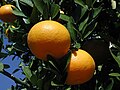 Iyokan on tree
 -
 Iyokan for sake in Kanagawa, Japan


