Medical gas supply: Difference between revisions
CSV import |
CSV import |
||
| Line 30: | Line 30: | ||
{{Medicine-stub}} | {{Medicine-stub}} | ||
{{Healthcare-stub}} | {{Healthcare-stub}} | ||
<gallery> | |||
File:BeaconMedaes_oxygen,_vacuum,_and_medical_air_medical_gas_supply_outlets_on_a_ceiling_at_Campbell_County_Memorial_Hospital_in_Gillette,_Wyoming.jpg|Medical gas supply outlets on a ceiling | |||
File:BOC_Medical_oxygen_tanks_Royal_Women's_Hospital.jpg|Medical oxygen tanks at Royal Women's Hospital | |||
</gallery> | |||
Latest revision as of 01:29, 18 February 2025
Medical gas supply refers to the systems used to provide a piped supply of medical gases to healthcare facilities. These systems are critical for the delivery of healthcare services, particularly in hospitals and clinics. The gases supplied typically include oxygen, nitrous oxide, medical air, and carbon dioxide, among others.
Overview[edit]
Medical gas supply systems are designed to provide a safe, reliable supply of medical gases to healthcare facilities. These systems are typically comprised of a central supply system, distribution piping, and outlet points located throughout the facility. The central supply system usually consists of bulk gas storage tanks or high-pressure gas cylinders, while the distribution piping is designed to deliver the gases to the point of use.
Types of Medical Gases[edit]
There are several types of medical gases used in healthcare facilities, each with its own specific uses and requirements for storage and delivery.
- Oxygen is the most commonly used medical gas. It is used in a variety of medical treatments and procedures, including anesthesia, respiratory therapy, and emergency medicine.
- Nitrous Oxide is used as an anesthetic and analgesic in both surgical and dental procedures.
- Medical Air is used to power medical devices and to provide ventilation for patients.
- Carbon Dioxide is used in a variety of medical procedures, including laparoscopic surgery and respiratory therapy.
Safety and Regulations[edit]
The safety of medical gas supply systems is of paramount importance. These systems are subject to stringent regulations and standards to ensure their safe operation. In the United States, the Food and Drug Administration (FDA) regulates medical gases as drugs, and the National Fire Protection Association (NFPA) sets standards for their storage and delivery.
See Also[edit]

| Health care | ||||||||||
|---|---|---|---|---|---|---|---|---|---|---|
* Category
|
-
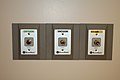 Medical gas supply outlets on a ceiling
 -
 Medical oxygen tanks at Royal Women's Hospital


