Candy apple: Difference between revisions
CSV import |
CSV import |
||
| Line 35: | Line 35: | ||
File:Pommes_d_amour.jpg | File:Pommes_d_amour.jpg | ||
File:Candy_Apple_(5819333319).jpg | File:Candy_Apple_(5819333319).jpg | ||
</gallery> | |||
<gallery> | |||
File:Tastee-Candy-Apple-Red-Caramel-wPeanuts.jpg|Candy apple with red caramel and peanuts | |||
File:Pommes_d_amour.jpg|Pommes d'amour (candy apples) | |||
File:Candy_Apple_(5819333319).jpg|Candy apple | |||
</gallery> | </gallery> | ||
Revision as of 01:09, 18 February 2025
Candy Apple
A candy apple (also known as a toffee apple outside of North America), is a sweet treat made by coating an apple in a sugar syrup, often tinted red to resemble the fruit's natural color. The candy apple is a common treat at autumn festivals in Western culture due to the late-October peak of apple harvesting.
History
The candy apple was created in 1908 by William W. Kolb, a candy maker from Newark, New Jersey. He experimented with red cinnamon candy for the Christmas trade and dipped apples into it, creating a new confectionery item. The candy apples were an immediate success, and Kolb's business boomed.
Preparation
The process of making a candy apple involves dipping an apple on a stick into a boiling sugar syrup, which quickly cools and hardens upon the apple. The sugar syrup is traditionally dyed red, but can be customized with various colors and flavors. The apple is then left to cool and harden before being eaten.
Variations
There are many variations of the candy apple, including the caramel apple, which is coated in caramel instead of a sugar syrup. Other variations include the addition of nuts, chocolate, or other toppings after the apple is dipped in the syrup.
Health Concerns
Despite the apple at its core, a candy apple is a high-sugar food and is not considered a healthy option. It is recommended to enjoy candy apples in moderation.
See Also


.jpg)
-
Candy apple with red caramel and peanuts
-
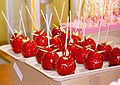 Pommes d'amour (candy apples)
 -
 Candy apple

