Housekeeping gene: Difference between revisions
CSV import Tags: mobile edit mobile web edit |
CSV import |
||
| Line 30: | Line 30: | ||
{{Molecular-biology-stub}} | {{Molecular-biology-stub}} | ||
{{Medicine-stub}} | {{Medicine-stub}} | ||
<gallery> | |||
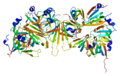
File:Protein_SREBF1_PDB_1am9.png|Housekeeping_gene | |||
File:Protein_SNRPB_PDB_1d3b.png|Housekeeping_gene | |||
</gallery> | |||
Latest revision as of 01:00, 18 February 2025
Housekeeping genes are a class of genes that are constitutively expressed in nearly all living cells. These genes are involved in basic cellular functions and are necessary for the maintenance of normal cellular activity. Unlike other genes that are expressed in a tissue-specific manner or are induced under certain conditions, housekeeping genes are consistently active to maintain cellular function and integrity.
Function[edit]
Housekeeping genes encode for essential cellular components, such as enzymes involved in metabolism, DNA repair proteins, ribosomal proteins, and components of the cytoskeleton. These genes are crucial for the basic operations of a cell, including energy production, cell structure maintenance, and the synthesis of molecules necessary for cell survival. The consistent expression of housekeeping genes ensures that cells have the necessary components to perform their basic functions at all times.
Characteristics[edit]
Housekeeping genes are characterized by their stable expression across different tissues and under various physiological and experimental conditions. This stability makes them useful as internal controls or reference genes in gene expression studies, such as quantitative PCR (qPCR) and microarray analysis. However, it's important to note that no gene has perfectly uniform expression under all conditions, and the selection of appropriate housekeeping genes is critical for accurate gene expression analysis.
Examples[edit]
Some well-known examples of housekeeping genes include:
- ACTB (Beta-actin), involved in cell structure and integrity.
- GAPDH (Glyceraldehyde 3-phosphate dehydrogenase), involved in glycolysis.
- HPRT1 (Hypoxanthine phosphoribosyltransferase 1), involved in the salvage pathway of purine metabolism.
- UBC (Ubiquitin C), involved in protein degradation.
Regulation[edit]
Despite their consistent expression, housekeeping genes are not uniformly regulated. Their expression is controlled by a variety of transcription factors and regulatory elements in their promoter regions, ensuring that their expression levels are maintained within a narrow range suitable for cell survival and function. This regulation is crucial, as even small deviations in the expression levels of these genes can have significant impacts on cell health and viability.
Research and Clinical Implications[edit]
Understanding the expression and regulation of housekeeping genes is important in both basic and clinical research. In gene expression studies, they serve as reference points to quantify the expression of other genes. In clinical settings, alterations in the expression of housekeeping genes can be indicative of diseases or abnormal states. For example, changes in the expression levels of certain housekeeping genes have been associated with cancer, indicating their potential role in tumorigenesis and as targets for therapy.
Conclusion[edit]
Housekeeping genes play a fundamental role in the maintenance of cellular function and integrity. Their consistent expression across different tissues and conditions makes them essential for the survival of cells. The study of housekeeping genes is crucial for understanding cellular biology and for the development of diagnostic and therapeutic strategies in medicine.


This article is a molecular biology stub. You can help WikiMD by expanding it!

-
 Housekeeping_gene
 -
 Housekeeping_gene


