Molten chocolate cake: Difference between revisions
CSV import |
CSV import |
||
| Line 22: | Line 22: | ||
[[Category:French cuisine]] | [[Category:French cuisine]] | ||
{{food-stub}} | {{food-stub}} | ||
<gallery> | |||
File:Molten_chocolate_cake.jpg|Molten chocolate cake | |||
File:Chocolate_Fondant.jpg|Chocolate fondant | |||
File:Chocolate_lava_cake.jpg|Chocolate lava cake | |||
File:Bromo_seltzer_newspaper.png|Bromo Seltzer newspaper advertisement | |||
</gallery> | |||
Revision as of 00:53, 18 February 2025
Molten chocolate cake or chocolate lava cake is a popular dessert that combines the elements of a flourless chocolate cake and a soufflé. Its name derives from the dessert's liquid chocolate center, and it is also known as chocolate moelleux (from French for "soft"), chocolate lava cake, or simply lava cake.
History
The dessert is relatively recent, having been invented in the 1980s. The French chef Jean-Georges Vongerichten is credited with its creation, although chef Jacques Torres disputes this, claiming that such a dessert already existed in France. Regardless of its origin, the molten chocolate cake has gained international fame and can be found on dessert menus worldwide.
Preparation
The main ingredients in molten chocolate cake are chocolate, butter, sugar, and eggs. The cake is typically baked in a ramekin. Despite its complex appearance, it is relatively simple to prepare. The cake is baked just long enough to hold its shape, but not long enough to fully cook the interior. This results in a dessert with a warm, liquid chocolate center that flows out when the cake is cut into, creating the "molten" or "lava" effect.
Variations
There are numerous variations of the molten chocolate cake. Some recipes incorporate additional flavorings, such as vanilla, espresso, or liqueur. Others include unique ingredients like peanut butter, caramel, or fruit fillings. There are also variations that cater to dietary restrictions, such as gluten-free or vegan molten chocolate cakes.
See also

-
 Molten chocolate cake
 -
 Chocolate fondant
 -
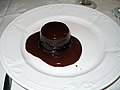 Chocolate lava cake
 -
 Bromo Seltzer newspaper advertisement


