Parboiling: Difference between revisions
CSV import |
CSV import |
||
| Line 26: | Line 26: | ||
[[Category:Food preparation]] | [[Category:Food preparation]] | ||
{{food-stub}} | {{food-stub}} | ||
== Parboiling == | |||
<gallery> | |||
File:Parboiling_peaches.jpg|Parboiling peaches | |||
File:Famiole_sbollentatura.jpg|Parboiling | |||
</gallery> | |||
Latest revision as of 00:53, 18 February 2025
Parboiling is a cooking process that partially cooks food, typically grains like rice, by boiling it briefly. This process is often used to reduce cooking time, enhance flavor, or improve the texture of the food.
History[edit]
The history of parboiling dates back to ancient times. It was a common practice in many cultures, including the Roman Empire, where it was used to prepare grains for storage or transport. The process was also used in the Middle Ages to preserve food for long journeys.
Process[edit]
Parboiling involves three main steps: soaking, steaming, and drying. The food is first soaked in water, which allows it to absorb moisture and begin the cooking process. It is then steamed until it is partially cooked, and finally dried to remove any remaining moisture. This process can vary depending on the type of food being parboiled and the desired end result.
Benefits[edit]
Parboiling has several benefits. It can reduce the cooking time of food, making it a convenient option for busy cooks. It can also enhance the flavor of food, as the soaking and steaming process can help to infuse it with flavor. Additionally, parboiling can improve the texture of food, making it softer and easier to eat.
Uses[edit]
Parboiling is commonly used in the preparation of rice, particularly in dishes like pilaf and biryani. It is also used in the preparation of other grains, like barley and oats, as well as some vegetables, like potatoes and carrots.
See also[edit]

Parboiling[edit]
-
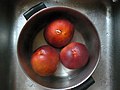 Parboiling peaches
 -
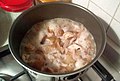 Parboiling


