Inocarpus fagifer: Difference between revisions
CSV import |
CSV import |
||
| Line 22: | Line 22: | ||
[[Category:Flora of the Pacific]] | [[Category:Flora of the Pacific]] | ||
{{plants-stub}} | {{plants-stub}} | ||
<gallery> | |||
File:Inocarpus_fagifer.jpg|Inocarpus fagifer tree | |||
File:Inocarpus_edulis.jpg|Inocarpus edulis leaves | |||
File:Inocarpus_edulis,_fruit.jpg|Inocarpus edulis fruit | |||
File:Levulinic_acid_family.svg|Levulinic acid family diagram | |||
</gallery> | |||
Revision as of 00:49, 18 February 2025
Inocarpus fagifer, also known as the Tahitian chestnut, is a species of flowering plant in the pea family, Fabaceae. It is native to Southeast Asia and the Pacific Islands, where it is cultivated for its edible nuts.
Description
Inocarpus fagifer is a large tree that can reach up to 20 meters in height. The leaves are pinnate, with 9-19 leaflets, each leaflet 9-20 cm long and 3-7 cm broad. The flowers are produced in racemes 15-60 cm long, each flower 2-3 cm diameter with five yellowish-white petals. The fruit is a drupe 4-6 cm diameter, green maturing brown, and containing one to four seeds.
Distribution and habitat
Inocarpus fagifer is native to the tropical rainforests of Southeast Asia, Melanesia, Micronesia, Polynesia, and the Pacific Islands. It is typically found in lowland forests and coastal areas, where it grows in a variety of soil types.
Uses
The seeds of Inocarpus fagifer are edible and are often used in traditional Pacific Islander cuisine. They can be eaten raw or cooked and have a taste similar to a chestnut. The wood of the tree is also used for making tools, building materials, and for firewood.
Conservation
While Inocarpus fagifer is not currently considered to be at risk of extinction, it is threatened by habitat loss due to deforestation and the conversion of land for agriculture.
See also
This plant related article is a stub. You can help WikiMD by expanding it.
-
Inocarpus fagifer tree
-
 Inocarpus edulis leaves
 -
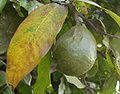 Inocarpus edulis fruit
 -
 Levulinic acid family diagram


