Volinanserin: Difference between revisions
CSV import Tags: mobile edit mobile web edit |
CSV import |
||
| Line 33: | Line 33: | ||
{{Pharma-stub}} | {{Pharma-stub}} | ||
{{Medicine-stub}} | {{Medicine-stub}} | ||
<gallery> | |||
File:MDL-100,907_structure.png|Structure of MDL-100,907 | |||
File:Volinanserin_synthesis.svg|Synthesis of Volinanserin | |||
File:3-Iodothyronamine_3D_ball.png|3D ball model of 3-Iodothyronamine | |||
</gallery> | |||
Latest revision as of 00:43, 18 February 2025
Volinanserin is a drug that was developed by Actelion for the treatment of insomnia. It is a selective antagonist of the serotonin 5-HT2A receptor, which is a type of G protein-coupled receptor found in the central nervous system.
History[edit]
Volinanserin was first synthesized in the late 1990s by a team of researchers at Actelion, a Swiss pharmaceutical company. The drug was developed as a potential treatment for insomnia, a common sleep disorder characterized by difficulty falling asleep or staying asleep.
Pharmacology[edit]
Volinanserin is a selective antagonist of the 5-HT2A receptor, a type of G protein-coupled receptor found in the central nervous system. This receptor is primarily involved in the regulation of neurotransmission and neuroendocrine secretion. By blocking the activity of this receptor, Volinanserin is thought to promote sleep by reducing the activity of the brain's arousal system.
Clinical trials[edit]
In clinical trials, Volinanserin was found to be effective in improving sleep quality and increasing total sleep time in patients with insomnia. However, the drug was also associated with some side effects, including dizziness, nausea, and headache.
Current status[edit]
As of 2021, Volinanserin is not currently approved for use in any country. Actelion discontinued the development of the drug in 2008 due to concerns about its side effect profile.
See also[edit]


-
 Structure of MDL-100,907
 -
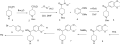 Synthesis of Volinanserin
 -
 3D ball model of 3-Iodothyronamine


