Linzagolix: Difference between revisions
CSV import Tags: mobile edit mobile web edit |
CSV import |
||
| Line 25: | Line 25: | ||
{{medicine-stub}} | {{medicine-stub}} | ||
<gallery> | |||
File:Linzagolix.svg|Linzagolix chemical structure | |||
File:Linzagolix_molecule_ball.png|Linzagolix molecule ball-and-stick model | |||
</gallery> | |||
Latest revision as of 01:58, 17 February 2025
Linzagolix is a gonadotropin-releasing hormone antagonist (GnRH antagonist) that is used in the treatment of endometriosis and uterine fibroids. It is developed by ObsEva, a Swiss biopharmaceutical company.
Mechanism of action[edit]
Linzagolix works by blocking the gonadotropin-releasing hormone (GnRH) receptors in the pituitary gland. This prevents the production of luteinizing hormone (LH) and follicle-stimulating hormone (FSH), which in turn reduces the production of estrogen by the ovaries. The reduction in estrogen levels helps to shrink endometriosis lesions and uterine fibroids.
Clinical trials[edit]
Linzagolix has undergone several clinical trials to evaluate its safety and efficacy. The Phase 3 EDELWEISS trial evaluated the efficacy and safety of linzagolix in women with endometriosis-associated pain. The PRIMROSE trials evaluated the efficacy and safety of linzagolix in women with heavy menstrual bleeding associated with uterine fibroids.
Side effects[edit]
Common side effects of linzagolix include hot flashes, insomnia, and mood swings. Less common but more serious side effects can include bone loss due to the reduction in estrogen levels.
See also[edit]
| GnRH antagonists | ||||||
|---|---|---|---|---|---|---|
This GnRH antagonist related article is a stub.
|
| Endometriosis | ||||||||
|---|---|---|---|---|---|---|---|---|
This Endometriosis related article is a stub.
|
0

-
 Linzagolix chemical structure
 -
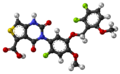 Linzagolix molecule ball-and-stick model


