Poriyal: Difference between revisions
CSV import Tags: mobile edit mobile web edit |
CSV import |
||
| Line 24: | Line 24: | ||
{{Indian-cuisine-stub}} | {{Indian-cuisine-stub}} | ||
<gallery> | |||
File:Poriyal.jpg|Poriyal | |||
File:Murungakai_Keerai_Poriyal.jpg|Murungakai Keerai Poriyal | |||
</gallery> | |||
Latest revision as of 01:52, 17 February 2025
Poriyal is a term used in South Indian cuisine to refer to a method of cooking in which vegetables are sautéed and spiced, often with grated coconut. The term is Tamil in origin and is used primarily in the states of Tamil Nadu, Kerala, and parts of Karnataka and Andhra Pradesh. Poriyal is typically served as a side dish to accompany rice and is a staple of the South Indian diet.
Etymology[edit]
The term 'Poriyal' is derived from the Tamil word 'poritha' meaning 'to fry' or 'to sauté'. It is a common term used in Tamil households and is recognized throughout the South Indian region.
Preparation[edit]
The preparation of Poriyal involves sautéing vegetables in oil, typically coconut oil or vegetable oil, along with spices such as mustard seeds, cumin seeds, and urad dal. The vegetables are then cooked until tender and mixed with grated coconut. The dish is typically garnished with curry leaves and served hot.
Variations[edit]
There are many variations of Poriyal, each using different vegetables and spices. Some of the most common vegetables used include cabbage, carrots, beans, and potatoes. The spices used can also vary, with some recipes including turmeric, chili powder, and coriander powder.
Nutrition[edit]
Poriyal is a healthy dish as it is primarily made up of vegetables. The addition of coconut adds a source of healthy fats, while the spices used provide various health benefits. However, the nutritional content can vary depending on the specific vegetables and spices used.
See also[edit]

-
 Poriyal
 -
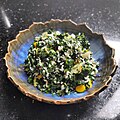 Murungakai Keerai Poriyal


