Adaptive value: Difference between revisions
CSV import |
CSV import Tags: mobile edit mobile web edit |
||
| Line 52: | Line 52: | ||
[[Category:Evolutionary biology]] | [[Category:Evolutionary biology]] | ||
[[Category:Natural selection]] | [[Category:Natural selection]] | ||
<gallery> | |||
File:Evolution_sm.png | |||
File:Allele-frequency.png | |||
</gallery> | |||
Latest revision as of 01:52, 17 February 2025
Adaptive Value[edit]

Adaptive value refers to the extent to which a particular trait or behavior increases the fitness of an organism, thereby enhancing its chances of survival and reproduction in a given environment. This concept is central to the theory of natural selection, a key mechanism of evolution.
Overview[edit]
Adaptive value is a measure of how well a particular trait or behavior contributes to an organism's ability to survive and reproduce. Traits with high adaptive value are more likely to be passed on to subsequent generations, as they confer advantages that improve an organism's reproductive success. Conversely, traits with low adaptive value may be selected against and become less common in a population over time.
Mechanisms[edit]
Adaptive value is influenced by several mechanisms, including:
- Natural selection: The process by which traits that enhance survival and reproduction become more common in successive generations.
- Sexual selection: A form of natural selection where traits that increase an individual's chances of mating are favored.
- Genetic drift: Random changes in allele frequencies that can lead to changes in trait prevalence, especially in small populations.
- Mutation: The introduction of new genetic variations that can potentially increase adaptive value if they confer a survival advantage.
Examples[edit]
- The camouflage of a chameleon, which allows it to blend into its environment and avoid predators, is an example of a trait with high adaptive value.
- The long neck of a giraffe, which enables it to reach leaves high in trees, is another example of a trait with significant adaptive value.
Role in Evolution[edit]
Adaptive value plays a crucial role in the process of evolution. Traits that enhance an organism's ability to survive and reproduce are more likely to be passed on to future generations. Over time, this can lead to the development of new species as populations adapt to their environments.

Related Concepts[edit]
Related Pages[edit]
Gallery[edit]
-
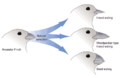 Diagram illustrating the process of evolution.
 -
 Graph showing changes in allele frequency.
