Adenosine deaminase 2 deficiency: Difference between revisions
CSV import |
CSV import |
||
| Line 45: | Line 45: | ||
[[Category:Immunodeficiency]] | [[Category:Immunodeficiency]] | ||
[[Category:Rare diseases]] | [[Category:Rare diseases]] | ||
== Adenosine deaminase 2 deficiency == | |||
<gallery> | |||
File:Autosomal_recessive_-_en.svg | |||
</gallery> | |||
Revision as of 22:07, 16 February 2025
Adenosine deaminase 2 deficiency
A rare genetic disorder affecting the immune system
Adenosine deaminase 2 deficiency (DADA2) is a rare genetic disorder characterized by a deficiency in the enzyme adenosine deaminase 2 (ADA2). This condition primarily affects the immune system, leading to a range of symptoms including vasculitis, immunodeficiency, and hematological abnormalities.
Genetics
DADA2 is inherited in an autosomal recessive pattern, meaning that an individual must inherit two copies of the defective gene, one from each parent, to manifest the disease. The gene responsible for DADA2 is the CECR1 gene, which encodes the ADA2 enzyme. Mutations in this gene lead to reduced or absent activity of ADA2, resulting in the clinical manifestations of the disorder.
Pathophysiology
The ADA2 enzyme is involved in the breakdown of adenosine and deoxyadenosine, which are important for normal immune function. Deficiency in ADA2 leads to the accumulation of these substrates, causing immune dysregulation and inflammation. The exact mechanisms by which ADA2 deficiency leads to the diverse symptoms observed in DADA2 are still under investigation.
Clinical Features
Patients with DADA2 may present with a variety of symptoms, including:
- Vasculitis, particularly affecting small and medium-sized blood vessels
- Strokes, often occurring in childhood
- Fever
- Rash
- Hepatosplenomegaly
- Anemia and other blood cell abnormalities
- Immunodeficiency, leading to increased susceptibility to infections
Diagnosis
The diagnosis of DADA2 is based on clinical evaluation, laboratory findings, and genetic testing. Measurement of ADA2 enzyme activity in the blood can support the diagnosis, but genetic testing for mutations in the CECR1 gene is definitive.
Treatment
There is no cure for DADA2, but treatment focuses on managing symptoms and preventing complications. Immunosuppressive therapy may be used to control inflammation, and anti-TNF therapy has shown effectiveness in some patients. Hematopoietic stem cell transplantation may be considered in severe cases.
Prognosis
The prognosis for individuals with DADA2 varies depending on the severity of the symptoms and the effectiveness of treatment. Early diagnosis and management are crucial for improving outcomes.
Related pages
Gallery
-
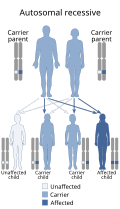 Diagram of autosomal recessive inheritance

