Aid climbing: Difference between revisions
CSV import |
CSV import |
||
| Line 1: | Line 1: | ||
Aid climbing | |||
[[File:Tatryhakowka.jpg|thumb|Aid climbing in the | [[File:Tatryhakowka.jpg|thumb|Aid climbing in the Tatra Mountains]] | ||
'''Aid climbing''' is a style of | '''Aid climbing''' is a style of climbing in which climbers use equipment placed in the rock to support their weight and assist in their ascent. This technique is often employed when the natural features of the rock are insufficient for free climbing. | ||
== History == | ==History== | ||
Aid climbing has a rich history, evolving from the early days of mountaineering when climbers used rudimentary tools to ascend difficult sections of rock. The development of specialized equipment, such as [[pitons]], [[cams]], and [[ascenders]], has allowed climbers to tackle increasingly challenging routes. | |||
Aid climbing | ==Techniques== | ||
Aid climbing involves a variety of techniques and equipment. Climbers use [[aiders]] or [[etriers]], which are ladder-like devices, to step up and reach higher placements. A [[daisy chain]] is often used to connect the climber to the gear, allowing for adjustments in length and position. | |||
[[ | ===Placement of Gear=== | ||
The placement of gear is crucial in aid climbing. Climbers use [[pitons]], [[nuts]], [[cams]], and other devices to create secure anchor points. The choice of gear depends on the type of rock and the specific features of the route. | |||
== | ===Progression=== | ||
Progression in aid climbing involves moving from one piece of gear to the next. Climbers must carefully test each placement before committing their weight to it. This process requires patience and precision. | |||
Aid climbing | ==Equipment== | ||
Aid climbing requires specialized equipment, including: | |||
* | * [[Aiders]] or [[etriers]] | ||
* | * [[Daisy chains]] | ||
* | * [[Pitons]] | ||
* | * [[Cams]] | ||
* [[Nuts]] | |||
* [[Skyhooks]] | |||
[[File:Laddder_aider.jpg|thumb| | [[File:Laddder_aider.jpg|thumb|Aider used in aid climbing]] | ||
[[File:Daisychainclimbing.JPG|thumb|Daisy chain used in aid climbing]] | |||
== | ==Famous Aid Climbs== | ||
Some of the most famous aid climbs include routes on [[El Capitan]] in [[Yosemite National Park]], such as [[The Shield]] and [[The Nose]]. These routes are known for their technical difficulty and require a high level of skill and experience. | |||
Aid climbing | [[File:The_Shield_P25_Yosemite.jpg|thumb|The Shield, a famous aid climbing route on El Capitan]] | ||
[[File:Aid_climbing_on_El_Capitan.JPG|thumb|Aid climbing on El Capitan]] | |||
==Notable Climbers== | |||
Several climbers have made significant contributions to the development of aid climbing techniques and equipment. [[Royal Robbins]] is one such pioneer, known for his first ascents and innovations in climbing gear. | |||
[[File:Royal_Robbins_by_Tom_Frost.jpg|thumb|Royal Robbins, a pioneer in aid climbing]] | |||
[[File: | |||
==Related pages== | |||
* [[Free climbing]] | * [[Free climbing]] | ||
* [[Rock climbing]] | |||
* [[Mountaineering]] | * [[Mountaineering]] | ||
* [[ | * [[Climbing equipment]] | ||
==Gallery== | |||
<gallery> | <gallery> | ||
File:Skyhook.jpg|Skyhook used in aid climbing | |||
File:Skyhook.jpg|Skyhook | File:Profilhaken.jpg|Profilhaken, a type of piton | ||
File:Profilhaken.jpg|Profilhaken | File:Aid_Climbing_Peter_Pan_Mont_Peney_III.jpg|Aid climbing on Mont Peney | ||
File:El_Capitan_Aid_Climbing_-_Copy.webp|Aid climbing on El Capitan | |||
File:Aid_Climbing_Peter_Pan_Mont_Peney_III.jpg|Aid climbing | File:Cerro_Torre_headwall.JPG|Aid climbing on Cerro Torre | ||
File:El_Capitan_Aid_Climbing_-_Copy.webp| | |||
File:Cerro_Torre_headwall.JPG|Cerro Torre | |||
</gallery> | </gallery> | ||
[[Category:Climbing]] | [[Category:Climbing]] | ||
Latest revision as of 21:59, 11 February 2025
Aid climbing

Aid climbing is a style of climbing in which climbers use equipment placed in the rock to support their weight and assist in their ascent. This technique is often employed when the natural features of the rock are insufficient for free climbing.
History[edit]
Aid climbing has a rich history, evolving from the early days of mountaineering when climbers used rudimentary tools to ascend difficult sections of rock. The development of specialized equipment, such as pitons, cams, and ascenders, has allowed climbers to tackle increasingly challenging routes.
Techniques[edit]
Aid climbing involves a variety of techniques and equipment. Climbers use aiders or etriers, which are ladder-like devices, to step up and reach higher placements. A daisy chain is often used to connect the climber to the gear, allowing for adjustments in length and position.
Placement of Gear[edit]
The placement of gear is crucial in aid climbing. Climbers use pitons, nuts, cams, and other devices to create secure anchor points. The choice of gear depends on the type of rock and the specific features of the route.
Progression[edit]
Progression in aid climbing involves moving from one piece of gear to the next. Climbers must carefully test each placement before committing their weight to it. This process requires patience and precision.
Equipment[edit]
Aid climbing requires specialized equipment, including:


Famous Aid Climbs[edit]
Some of the most famous aid climbs include routes on El Capitan in Yosemite National Park, such as The Shield and The Nose. These routes are known for their technical difficulty and require a high level of skill and experience.

Notable Climbers[edit]
Several climbers have made significant contributions to the development of aid climbing techniques and equipment. Royal Robbins is one such pioneer, known for his first ascents and innovations in climbing gear.
Related pages[edit]
Gallery[edit]
-
 Skyhook used in aid climbing
 -
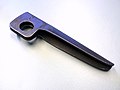 Profilhaken, a type of piton
 -
 Aid climbing on Mont Peney
 -
 Aid climbing on El Capitan
 -
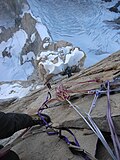 Aid climbing on Cerro Torre


