Arthrodermataceae: Difference between revisions
CSV import |
CSV import |
||
| Line 1: | Line 1: | ||
{{Short description|Family of fungi}} | |||
{{Taxobox | |||
| name = Arthrodermataceae | |||
| image = Aprotinin.png | |||
| image_caption = Aprotinin, a protein related to the study of Arthrodermataceae | |||
| regnum = [[Fungi]] | |||
| divisio = [[Ascomycota]] | |||
| classis = [[Eurotiomycetes]] | |||
| ordo = [[Onygenales]] | |||
| familia = '''Arthrodermataceae''' | |||
| familia_authority = [[C.W. Emmons]] | |||
}} | |||
The '''Arthrodermataceae''' is a family of [[fungi]] within the order [[Onygenales]]. This family includes several genera that are of medical and veterinary importance due to their role in causing [[dermatophytosis]], commonly known as ringworm, in humans and animals. | |||
==Characteristics== | |||
Members of the Arthrodermataceae family are characterized by their ability to degrade [[keratin]], a fibrous structural protein found in skin, hair, and nails. This keratinolytic activity is a key feature that enables these fungi to colonize and infect keratinized tissues, leading to dermatophytic infections. | |||
The fungi in this family are typically [[ascomycetes]], meaning they reproduce sexually through the formation of [[ascospores]] within a specialized structure called an [[ascus]]. They can also reproduce asexually through the production of [[conidia]], which are asexual spores that facilitate dissemination and infection. | |||
==Genera== | |||
The family Arthrodermataceae includes several genera, some of which are: | |||
* '''[[Arthroderma]]''' | |||
* '''[[Ctenomyces]]''' | |||
* '''[[Epidermophyton]]''' | |||
* '''[[Microsporum]]''' | |||
* '''[[Nannizzia]]''' | |||
* '''[[Trichophyton]]''' | |||
These genera include species that are well-known pathogens, such as ''[[Trichophyton rubrum]]'' and ''[[Microsporum canis]]'', which are common causes of ringworm in humans and animals. | |||
== | ==Pathogenicity== | ||
The pathogenic species within the Arthrodermataceae family are known as [[dermatophytes]]. They are responsible for a variety of infections, collectively referred to as dermatophytosis. These infections are typically superficial, affecting the skin, hair, and nails, but can cause significant discomfort and are highly contagious. | |||
Dermatophytes are classified into three ecological groups based on their primary habitat: | |||
== | * '''Anthropophilic''': Preferring human hosts, e.g., ''Trichophyton rubrum''. | ||
* '''Zoophilic''': Preferring animal hosts, e.g., ''Microsporum canis''. | |||
* '''Geophilic''': Preferring soil, e.g., ''Nannizzia gypsea''. | |||
==Medical Importance== | |||
Infections caused by dermatophytes are common worldwide and can affect individuals of all ages. The clinical manifestations of dermatophytosis vary depending on the site of infection and the species involved. Common forms include: | |||
* '''[[Tinea pedis]]''' (athlete's foot) | |||
* '''[[Tinea corporis]]''' (ringworm of the body) | |||
* '''[[Tinea capitis]]''' (scalp ringworm) | |||
* '''[[Tinea unguium]]''' (nail infection) | |||
Treatment typically involves the use of topical or oral antifungal medications, depending on the severity and location of the infection. | |||
==Research and Applications== | |||
Research into the Arthrodermataceae family has provided insights into fungal pathogenicity, host-pathogen interactions, and the development of antifungal therapies. Understanding the genetic and biochemical pathways involved in keratin degradation has potential applications in biotechnology and medicine. | |||
==Gallery== | |||
<gallery> | |||
File:Aprotinin.png|Aprotinin, a protein related to the study of Arthrodermataceae | |||
File:BPTI_seq_ribbon_sticks.jpg|Structural representation of a protein related to fungal studies | |||
</gallery> | |||
==Related pages== | |||
* [[Dermatophyte]] | * [[Dermatophyte]] | ||
* [[Onygenales]] | * [[Onygenales]] | ||
* [[ | * [[Ascomycota]] | ||
* [[Fungal infection]] | |||
[[Category: | [[Category:Arthrodermataceae]] | ||
[[Category:Onygenales]] | [[Category:Onygenales]] | ||
[[Category: | [[Category:Ascomycota families]] | ||
Revision as of 18:43, 11 February 2025
Family of fungi
The Arthrodermataceae is a family of fungi within the order Onygenales. This family includes several genera that are of medical and veterinary importance due to their role in causing dermatophytosis, commonly known as ringworm, in humans and animals.
Characteristics
Members of the Arthrodermataceae family are characterized by their ability to degrade keratin, a fibrous structural protein found in skin, hair, and nails. This keratinolytic activity is a key feature that enables these fungi to colonize and infect keratinized tissues, leading to dermatophytic infections.
The fungi in this family are typically ascomycetes, meaning they reproduce sexually through the formation of ascospores within a specialized structure called an ascus. They can also reproduce asexually through the production of conidia, which are asexual spores that facilitate dissemination and infection.
Genera
The family Arthrodermataceae includes several genera, some of which are:
These genera include species that are well-known pathogens, such as Trichophyton rubrum and Microsporum canis, which are common causes of ringworm in humans and animals.
Pathogenicity
The pathogenic species within the Arthrodermataceae family are known as dermatophytes. They are responsible for a variety of infections, collectively referred to as dermatophytosis. These infections are typically superficial, affecting the skin, hair, and nails, but can cause significant discomfort and are highly contagious.
Dermatophytes are classified into three ecological groups based on their primary habitat:
- Anthropophilic: Preferring human hosts, e.g., Trichophyton rubrum.
- Zoophilic: Preferring animal hosts, e.g., Microsporum canis.
- Geophilic: Preferring soil, e.g., Nannizzia gypsea.
Medical Importance
Infections caused by dermatophytes are common worldwide and can affect individuals of all ages. The clinical manifestations of dermatophytosis vary depending on the site of infection and the species involved. Common forms include:
- Tinea pedis (athlete's foot)
- Tinea corporis (ringworm of the body)
- Tinea capitis (scalp ringworm)
- Tinea unguium (nail infection)
Treatment typically involves the use of topical or oral antifungal medications, depending on the severity and location of the infection.
Research and Applications
Research into the Arthrodermataceae family has provided insights into fungal pathogenicity, host-pathogen interactions, and the development of antifungal therapies. Understanding the genetic and biochemical pathways involved in keratin degradation has potential applications in biotechnology and medicine.
Gallery
-
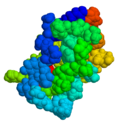 Aprotinin, a protein related to the study of Arthrodermataceae
 -
 Structural representation of a protein related to fungal studies


