Tteok: Difference between revisions
CSV import |
CSV import |
||
| Line 1: | Line 1: | ||
== Tteok == | |||
'''Tteok''' (_) is a class of Korean [[rice cake]]s made with glutinous or non-glutinous rice. It is a staple in Korean cuisine and is often served during special occasions, celebrations, and festivals. Tteok can be steamed, pounded, boiled, or pan-fried, and it comes in a variety of shapes, sizes, and flavors. | |||
== | == History == | ||
Tteok has a long history in Korea, dating back to ancient times. It was traditionally made during harvest festivals and other important events. The process of making tteok was labor-intensive, often involving the use of a [[jeolgu]] (__), a large mortar and pestle, to pound the rice into a sticky dough. | |||
== Types of Tteok == | |||
There are many different types of tteok, each with its own unique preparation method and ingredients. | |||
== | === Baekseolgi === | ||
[[Baekseolgi]] (___) is a type of steamed tteok made with non-glutinous rice flour. It is white in color and has a soft, fluffy texture. Baekseolgi is often used in celebrations such as birthdays and weddings. | |||
== | === Injeolmi === | ||
[[Injeolmi]] (___) is a chewy variety of tteok made by steaming and pounding glutinous rice. It is coated with powdered soybeans or other ingredients like sesame seeds or red bean powder. | |||
=== Tteokbokki === | |||
[[Tteokbokki]] (___) is a popular Korean street food made with cylindrical rice cakes, fish cakes, and a spicy gochujang-based sauce. It is often garnished with boiled eggs and scallions. | |||
=== Songpyeon === | |||
[[Songpyeon]] (__) is a half-moon shaped tteok filled with sweet fillings such as sesame seeds, red bean paste, or chestnut paste. It is traditionally made during the [[Chuseok]] holiday. | |||
== Preparation == | |||
The preparation of tteok varies depending on the type. Common methods include steaming in a [[siru]] (__), a traditional Korean steamer, or pounding with a jeolgu. Ingredients such as red beans, mung beans, and various nuts and seeds are often added for flavor and texture. | |||
== Cultural Significance == | |||
Tteok holds significant cultural importance in Korea. It is often used in rituals and ceremonies, symbolizing good fortune and prosperity. Tteok is also a common gift during holidays and special occasions. | |||
== Related Pages == | |||
* [[Korean cuisine]] | * [[Korean cuisine]] | ||
* [[ | * [[Chuseok]] | ||
* [[ | * [[Gochujang]] | ||
== | == Gallery == | ||
< | <gallery> | ||
File:Tteok.jpg|Various types of tteok | |||
File:Siru_(rice_cake_steamer).jpg|Siru, a rice cake steamer | |||
File:Baek-seolgi.jpg|Baekseolgi | |||
File:Sultteok.jpg|Sultteok | |||
File:Injeolmi_(tteok)_(rice_cake).jpg|Injeolmi | |||
File:Tteokbokki.JPG|Tteokbokki | |||
File:Korean.dessert-Tteok-Songpyeon-Kkultteok.01.jpg|Songpyeon and Kkultteok | |||
File:Korea-Sokcho-2007_Seorak_Festival-06.jpg|Tteok at a festival | |||
File:Korean.Folk.Village-Minsokchon-25.jpg|Traditional tteok making | |||
File:Korea-Seoul-Insadong-Pounding_tteok-02.jpg|Pounding tteok in Insadong | |||
File:Sirutteok.jpg|Sirutteok | |||
File:Hobakseolgitteok_(pumpkin_seolgi_tteok).jpg|Hobakseolgitteok | |||
File:Sultteok.jpg|Sultteok | |||
File:Rice_cake_ball.jpg|Rice cake ball | |||
</gallery> | |||
[[Category:Korean cuisine]] | [[Category:Korean cuisine]] | ||
[[Category:Rice cakes]] | [[Category:Rice cakes]] | ||
Revision as of 01:15, 10 February 2025
Tteok
Tteok (_) is a class of Korean rice cakes made with glutinous or non-glutinous rice. It is a staple in Korean cuisine and is often served during special occasions, celebrations, and festivals. Tteok can be steamed, pounded, boiled, or pan-fried, and it comes in a variety of shapes, sizes, and flavors.
History
Tteok has a long history in Korea, dating back to ancient times. It was traditionally made during harvest festivals and other important events. The process of making tteok was labor-intensive, often involving the use of a jeolgu (__), a large mortar and pestle, to pound the rice into a sticky dough.
Types of Tteok
There are many different types of tteok, each with its own unique preparation method and ingredients.
Baekseolgi
Baekseolgi (___) is a type of steamed tteok made with non-glutinous rice flour. It is white in color and has a soft, fluffy texture. Baekseolgi is often used in celebrations such as birthdays and weddings.
Injeolmi
Injeolmi (___) is a chewy variety of tteok made by steaming and pounding glutinous rice. It is coated with powdered soybeans or other ingredients like sesame seeds or red bean powder.
Tteokbokki
Tteokbokki (___) is a popular Korean street food made with cylindrical rice cakes, fish cakes, and a spicy gochujang-based sauce. It is often garnished with boiled eggs and scallions.
Songpyeon
Songpyeon (__) is a half-moon shaped tteok filled with sweet fillings such as sesame seeds, red bean paste, or chestnut paste. It is traditionally made during the Chuseok holiday.
Preparation
The preparation of tteok varies depending on the type. Common methods include steaming in a siru (__), a traditional Korean steamer, or pounding with a jeolgu. Ingredients such as red beans, mung beans, and various nuts and seeds are often added for flavor and texture.
Cultural Significance
Tteok holds significant cultural importance in Korea. It is often used in rituals and ceremonies, symbolizing good fortune and prosperity. Tteok is also a common gift during holidays and special occasions.
Related Pages
Gallery
-
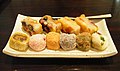 Various types of tteok
 -
Siru, a rice cake steamer
-
Baekseolgi
-
Sultteok
-
Injeolmi
-
Tteokbokki
-
Songpyeon and Kkultteok
-
Tteok at a festival
-
Traditional tteok making
-
Pounding tteok in Insadong
-
Sirutteok
-
Hobakseolgitteok
-
Sultteok
-
Rice cake ball


.jpg)


_(rice_cake).jpg)


.jpg)
