Tropicamide: Difference between revisions
CSV import Tags: mobile edit mobile web edit |
CSV import |
||
| Line 1: | Line 1: | ||
{{Short description|A medication used to dilate the pupil}} | |||
{{Drugbox | |||
| verifiedfields = changed | |||
| verifiedrevid = 477002123 | |||
| image = Tropicamide.svg | |||
| width = 200 | |||
}} | |||
'''Tropicamide''' is a medication primarily used to dilate the pupil for ophthalmic examinations. It is classified as a [[muscarinic receptor antagonist]] and is commonly used in [[optometry]] and [[ophthalmology]]. | |||
Tropicamide | |||
== | ==Medical uses== | ||
Tropicamide is | Tropicamide is used to facilitate the examination of the [[retina]] and other structures in the back of the eye. It is often administered in the form of eye drops. The drug works by temporarily paralyzing the muscles in the eye that constrict the pupil, allowing for a better view of the internal structures. | ||
== | ==Mechanism of action== | ||
Tropicamide functions as a [[muscarinic antagonist]], specifically blocking the [[muscarinic acetylcholine receptor]]s in the eye. This action inhibits the constriction of the pupil, leading to [[mydriasis]] (dilation of the pupil). The effect is usually temporary, with the pupil returning to its normal size after a few hours. | |||
== | ==Side effects== | ||
Common side effects of tropicamide include increased sensitivity to light (due to the dilated pupil) and blurred vision. In rare cases, it can cause an increase in [[intraocular pressure]], which may be a concern for individuals with [[glaucoma]]. | |||
==Pharmacokinetics== | |||
Tropicamide is rapidly absorbed into the eye, with effects typically beginning within 15 to 30 minutes after administration. The duration of action is relatively short, usually lasting for 4 to 8 hours. | |||
==Chemical structure== | |||
Tropicamide is a synthetic compound with the chemical formula C<sub>17</sub>H<sub>20</sub>N<sub>2</sub>O<sub>2</sub>. It is available as a racemic mixture, containing both the (R)- and (S)-enantiomers. | |||
<gallery> | |||
File:Anizokoria.JPG|Anisocoria induced by tropicamide | |||
File:(R)-Tropicamid_Structural_Formula_V1.svg|Structural formula of (R)-Tropicamide | |||
File:(S)-Tropicamid_Structural_Formula_V1.svg|Structural formula of (S)-Tropicamide | |||
</gallery> | |||
==History== | ==History== | ||
Tropicamide was first | Tropicamide was first introduced in the mid-20th century and has since become a standard agent for pupil dilation in eye examinations. Its rapid onset and short duration of action make it a preferred choice for many eye care professionals. | ||
==Related pages== | |||
* [[Mydriatic]] | |||
* [[Ophthalmology]] | |||
* [[Muscarinic antagonist]] | |||
== | ==References== | ||
{{Reflist}} | |||
[[Category:Ophthalmology]] | [[Category:Ophthalmology]] | ||
[[Category: | [[Category:Muscarinic antagonists]] | ||
Revision as of 00:02, 10 February 2025
A medication used to dilate the pupil
| Tropicamide | |
|---|---|

| |
| INN | |
| Drug class | |
| Routes of administration | |
| Pregnancy category | |
| Bioavailability | |
| Metabolism | |
| Elimination half-life | |
| Excretion | |
| Legal status | |
| CAS Number | |
| PubChem | |
| DrugBank | |
| ChemSpider | |
| KEGG | |
Tropicamide is a medication primarily used to dilate the pupil for ophthalmic examinations. It is classified as a muscarinic receptor antagonist and is commonly used in optometry and ophthalmology.
Medical uses
Tropicamide is used to facilitate the examination of the retina and other structures in the back of the eye. It is often administered in the form of eye drops. The drug works by temporarily paralyzing the muscles in the eye that constrict the pupil, allowing for a better view of the internal structures.
Mechanism of action
Tropicamide functions as a muscarinic antagonist, specifically blocking the muscarinic acetylcholine receptors in the eye. This action inhibits the constriction of the pupil, leading to mydriasis (dilation of the pupil). The effect is usually temporary, with the pupil returning to its normal size after a few hours.
Side effects
Common side effects of tropicamide include increased sensitivity to light (due to the dilated pupil) and blurred vision. In rare cases, it can cause an increase in intraocular pressure, which may be a concern for individuals with glaucoma.
Pharmacokinetics
Tropicamide is rapidly absorbed into the eye, with effects typically beginning within 15 to 30 minutes after administration. The duration of action is relatively short, usually lasting for 4 to 8 hours.
Chemical structure
Tropicamide is a synthetic compound with the chemical formula C17H20N2O2. It is available as a racemic mixture, containing both the (R)- and (S)-enantiomers.
-
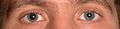 Anisocoria induced by tropicamide
 -
 Structural formula of (R)-Tropicamide
 -
 Structural formula of (S)-Tropicamide

-Tropicamid_Structural_Formula_V1.svg)
-Tropicamid_Structural_Formula_V1.svg)
History
Tropicamide was first introduced in the mid-20th century and has since become a standard agent for pupil dilation in eye examinations. Its rapid onset and short duration of action make it a preferred choice for many eye care professionals.
Related pages
References
<references group="" responsive="1"></references>
