Quinone methide: Difference between revisions
CSV import Tags: mobile edit mobile web edit |
|||
| Line 21: | Line 21: | ||
* [[Organic Chemistry]] | * [[Organic Chemistry]] | ||
* [[Chemical Reactions]] | * [[Chemical Reactions]] | ||
[[Category:Organic Compounds]] | [[Category:Organic Compounds]] | ||
| Line 32: | Line 28: | ||
<gallery> | <gallery> | ||
File:quinone methide.png|Quinone methide | File:quinone methide.png|Quinone methide | ||
File:SclerotizationReaction.svg|Sclerotization Reaction | File:SclerotizationReaction.svg|Sclerotization Reaction | ||
File:Kendomycin 2.png|Kendomycin | File:Kendomycin 2.png|Kendomycin | ||
</gallery> | </gallery> | ||
Latest revision as of 15:57, 8 March 2025
Quinone methide is a type of organic compound that is part of the quinone family. It is characterized by a carbonyl group (C=O) and a methide group (CH2) on a benzene ring. Quinone methides are highly reactive and can participate in a variety of chemical reactions, including Michael addition, Diels-Alder reaction, and nucleophilic addition.
Structure and Properties[edit]
Quinone methides have a unique structure that contributes to their reactivity. The carbonyl group is electron-withdrawing, which makes the methide group more susceptible to nucleophilic attack. In addition, the benzene ring provides stability to the molecule through resonance.
Quinone methides can exist in two forms: the open form and the closed form. The open form is more reactive and is often involved in chemical reactions. The closed form, on the other hand, is more stable and can be isolated and stored.
Synthesis[edit]
There are several methods for synthesizing quinone methides. One common method is the Fries rearrangement, which involves the reaction of a phenol with an acyl chloride in the presence of a Lewis acid. Another method is the Sommelet reaction, which involves the reaction of a benzylic halide with hexamethylenetetramine.
Applications[edit]
Quinone methides have a wide range of applications in organic chemistry. They are used as intermediates in the synthesis of various organic compounds, including dyes, pharmaceuticals, and polymers. They are also used in the production of photoresists in the semiconductor industry.
See Also[edit]

-
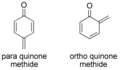 Quinone methide
 -
 Sclerotization Reaction
 -
 Kendomycin


