Temporal lobe epilepsy: Difference between revisions
CSV import |
CSV import |
||
| Line 1: | Line 1: | ||
{{SI}} | |||
{{Infobox medical condition | |||
| name = Temporal lobe epilepsy | |||
| image = [[File:Lobes_of_the_brain_NL.svg|250px]] | |||
| caption = The temporal lobe is highlighted in red. | |||
| field = [[Neurology]] | |||
| symptoms = [[Seizures]], [[aura (symptom)|auras]], [[memory loss]], [[déjà vu]], [[jamais vu]] | |||
| onset = Typically [[childhood]] or [[adolescence]] | |||
| duration = [[Chronic (medicine)|Chronic]] | |||
| types = [[Mesial temporal lobe epilepsy]], [[Neocortical temporal lobe epilepsy]] | |||
| causes = [[Brain injury]], [[infections]], [[genetic factors]] | |||
| risks = [[Family history]], [[head trauma]], [[febrile seizures]] | |||
| diagnosis = [[Electroencephalography|EEG]], [[Magnetic resonance imaging|MRI]] | |||
| differential = [[Other types of epilepsy]], [[psychogenic non-epileptic seizures]] | |||
| treatment = [[Anticonvulsant|Anticonvulsants]], [[surgery]], [[vagus nerve stimulation]] | |||
| prognosis = Varies; some achieve [[seizure control]], others may have [[intractable epilepsy]] | |||
| frequency = Common | |||
}} | |||
'''Temporal lobe epilepsy''' ('''TLE''') is a chronic neurological condition characterized by recurrent, unprovoked [[seizure]]s originating in the temporal lobe of the brain. It is the most common form of focal (or partial) [[epilepsy]] and represents approximately 60 percent of all patients with epilepsy. | '''Temporal lobe epilepsy''' ('''TLE''') is a chronic neurological condition characterized by recurrent, unprovoked [[seizure]]s originating in the temporal lobe of the brain. It is the most common form of focal (or partial) [[epilepsy]] and represents approximately 60 percent of all patients with epilepsy. | ||
== Symptoms == | == Symptoms == | ||
The symptoms experienced during a seizure will depend on the specific area of the brain where the seizure begins. In TLE, seizures often involve feelings of fear, anxiety, or a sense of | The symptoms experienced during a seizure will depend on the specific area of the brain where the seizure begins. In TLE, seizures often involve feelings of fear, anxiety, or a sense of déj√† vu. Other symptoms can include sensory changes, such as visual disturbances or changes in hearing, smell, taste, or touch. | ||
== Causes == | == Causes == | ||
TLE is often associated with a brain abnormality, such as [[hippocampal sclerosis]], which is a specific pattern of hippocampal cell loss. Other causes can include brain injury, infection, or abnormal blood vessels. However, in many cases, the cause of TLE is unknown. | TLE is often associated with a brain abnormality, such as [[hippocampal sclerosis]], which is a specific pattern of hippocampal cell loss. Other causes can include brain injury, infection, or abnormal blood vessels. However, in many cases, the cause of TLE is unknown. | ||
== Diagnosis == | == Diagnosis == | ||
Diagnosis of TLE typically involves a detailed medical history and neurological examination, as well as tests such as an [[electroencephalogram]] (EEG) to measure electrical activity in the brain, and imaging studies such as [[magnetic resonance imaging]] (MRI) to identify any structural abnormalities. | Diagnosis of TLE typically involves a detailed medical history and neurological examination, as well as tests such as an [[electroencephalogram]] (EEG) to measure electrical activity in the brain, and imaging studies such as [[magnetic resonance imaging]] (MRI) to identify any structural abnormalities. | ||
== Treatment == | == Treatment == | ||
Treatment for TLE typically involves medication to control seizures. In some cases, surgery may be considered if medication is not effective. | Treatment for TLE typically involves medication to control seizures. In some cases, surgery may be considered if medication is not effective. | ||
== Prognosis == | == Prognosis == | ||
The prognosis for individuals with TLE varies. Some individuals may have good seizure control with medication, while others may continue to have seizures despite treatment. | The prognosis for individuals with TLE varies. Some individuals may have good seizure control with medication, while others may continue to have seizures despite treatment. | ||
==Gallery== | |||
<gallery> | |||
File:CajalHippocampus_(modified).png|Cajal's drawing of the hippocampus | |||
File:Hippocampus-mri.jpg|MRI image of the hippocampus | |||
File:PET_Normal_brain.jpg|PET scan of a normal brain | |||
File:Epilepsy-surgery-in-progress.jpg|Surgery in progress for epilepsy treatment | |||
File:Vagus_nerve_stimulation.jpg|Vagus nerve stimulation device | |||
File:Peds_DBS.jpg|Deep Brain Stimulation (DBS) in pediatrics | |||
</gallery> | |||
== See also == | == See also == | ||
* [[Epilepsy]] | * [[Epilepsy]] | ||
| Line 22: | Line 43: | ||
* [[Electroencephalogram]] | * [[Electroencephalogram]] | ||
* [[Magnetic resonance imaging]] | * [[Magnetic resonance imaging]] | ||
[[Category:Neurological disorders]] | [[Category:Neurological disorders]] | ||
[[Category:Epilepsy]] | [[Category:Epilepsy]] | ||
{{stub}} | {{stub}} | ||
Latest revision as of 06:28, 6 April 2025

Editor-In-Chief: Prab R Tumpati, MD
Obesity, Sleep & Internal medicine
Founder, WikiMD Wellnesspedia &
W8MD's medical weight loss NYC, sleep center NYC
Philadelphia medical weight loss and Philadelphia sleep clinics
| Temporal lobe epilepsy | |
|---|---|

| |
| Synonyms | N/A |
| Pronounce | N/A |
| Specialty | N/A |
| Symptoms | Seizures, auras, memory loss, déjà vu, jamais vu |
| Complications | N/A |
| Onset | Typically childhood or adolescence |
| Duration | Chronic |
| Types | Mesial temporal lobe epilepsy, Neocortical temporal lobe epilepsy |
| Causes | Brain injury, infections, genetic factors |
| Risks | Family history, head trauma, febrile seizures |
| Diagnosis | EEG, MRI |
| Differential diagnosis | Other types of epilepsy, psychogenic non-epileptic seizures |
| Prevention | N/A |
| Treatment | Anticonvulsants, surgery, vagus nerve stimulation |
| Medication | N/A |
| Prognosis | Varies; some achieve seizure control, others may have intractable epilepsy |
| Frequency | Common |
| Deaths | N/A |
Temporal lobe epilepsy (TLE) is a chronic neurological condition characterized by recurrent, unprovoked seizures originating in the temporal lobe of the brain. It is the most common form of focal (or partial) epilepsy and represents approximately 60 percent of all patients with epilepsy.
Symptoms[edit]
The symptoms experienced during a seizure will depend on the specific area of the brain where the seizure begins. In TLE, seizures often involve feelings of fear, anxiety, or a sense of déj√† vu. Other symptoms can include sensory changes, such as visual disturbances or changes in hearing, smell, taste, or touch.
Causes[edit]
TLE is often associated with a brain abnormality, such as hippocampal sclerosis, which is a specific pattern of hippocampal cell loss. Other causes can include brain injury, infection, or abnormal blood vessels. However, in many cases, the cause of TLE is unknown.
Diagnosis[edit]
Diagnosis of TLE typically involves a detailed medical history and neurological examination, as well as tests such as an electroencephalogram (EEG) to measure electrical activity in the brain, and imaging studies such as magnetic resonance imaging (MRI) to identify any structural abnormalities.
Treatment[edit]
Treatment for TLE typically involves medication to control seizures. In some cases, surgery may be considered if medication is not effective.
Prognosis[edit]
The prognosis for individuals with TLE varies. Some individuals may have good seizure control with medication, while others may continue to have seizures despite treatment.
Gallery[edit]
-
 Cajal's drawing of the hippocampus
 -
 MRI image of the hippocampus
 -
 PET scan of a normal brain
 -
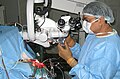 Surgery in progress for epilepsy treatment
 -
 Vagus nerve stimulation device
 -
 Deep Brain Stimulation (DBS) in pediatrics
.png)


