Callistoctopus macropus: Difference between revisions
CSV import |
CSV import |
||
| Line 38: | Line 38: | ||
<gallery> | <gallery> | ||
File:Octopus_macropus_Merculiano.jpg | File:Octopus_macropus_Merculiano.jpg | ||
</gallery> | |||
<gallery> | |||
File:Octopus_macropus.jpg|Callistoctopus macropus | |||
File:Octopus_macropus_Merculiano.jpg|Callistoctopus macropus | |||
</gallery> | </gallery> | ||
Revision as of 01:54, 18 February 2025
Callistoctopus macropus, also known as the Atlantic white-spotted octopus, Larger Pacific Striped Octopus, or Grass octopus, is a species of octopus belonging to the Octopodidae family. It is a marine animal known for its distinctive physical characteristics and behavior.
Description
The Callistoctopus macropus is a large octopus species, with adults reaching a total length of up to 150 cm. The body of the octopus is elongated with a narrow, elongated mantle. The skin of the octopus is smooth and has a unique pattern of white spots, which gives it its common name.
Distribution and Habitat
The Callistoctopus macropus is found in the Atlantic Ocean, Pacific Ocean, and the Mediterranean Sea. It prefers to live in sandy or muddy bottoms, where it can easily camouflage itself.
Behavior and Diet
The Callistoctopus macropus is a nocturnal creature, spending the day hiding in its den and coming out at night to hunt. Its diet primarily consists of crustaceans, mollusks, and small fish.
Reproduction
The mating behavior of the Callistoctopus macropus is unique among octopuses. The male approaches the female and inserts his hectocotylus into the female's mantle cavity to deposit spermatophores. The female then lays her eggs and guards them until they hatch.
Conservation Status
The Callistoctopus macropus is not currently listed as threatened or endangered. However, like all marine species, it is affected by pollution and habitat destruction.
See Also

This article is a cephalopod-related stub. You can help WikiMD by expanding it!
| This marine biology related article is a stub. You can help WikiMD by expanding it. |


-
 Callistoctopus macropus
 -
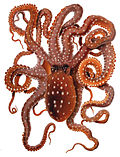 Callistoctopus macropus

