Archaeplastida: Difference between revisions
CSV import |
CSV import |
||
| Line 40: | Line 40: | ||
[[Category:Photosynthetic organisms]] | [[Category:Photosynthetic organisms]] | ||
[[Category:Eukaryotes]] | [[Category:Eukaryotes]] | ||
<gallery> | |||
File:Sprague_River_(Klamath_County,_Oregon_scenic_images)_(klaDA0073).jpg|Archaeplastida | |||
File:Glaucocystis_sp.jpg|Archaeplastida | |||
File:Laurencia.jpg|Archaeplastida | |||
File:Stigeoclonium_sp_zugespitzte_seitenzweige.jpeg|Archaeplastida | |||
File:Hemimastix_amphikineta.png|Archaeplastida | |||
File:Coccolithus_pelagicus.jpg|Archaeplastida | |||
File:Ammonia_tepida.jpg|Archaeplastida | |||
File:Cafeteria_roenbergensis_atcc50561_Protsville_(cropped).jpg|Archaeplastida | |||
File:Ceratium_furca.jpg|Archaeplastida | |||
File:Rhodomonas_salina_CCMP_322.jpg|Archaeplastida | |||
File:Large_Tree_-_panoramio.jpg|Archaeplastida | |||
File:Picomonas_judraskeda_(SEM).png|Archaeplastida | |||
</gallery> | |||
Revision as of 12:05, 18 February 2025
A group of eukaryotic organisms that includes land plants, green algae, and red algae
Archaeplastida is a major group of eukaryotes that includes the land plants, green algae, and red algae. This group is characterized by the presence of chloroplasts that are derived from an ancient endosymbiotic event with a cyanobacterium. Archaeplastida is one of the primary groups of photosynthetic organisms on Earth and plays a crucial role in the global carbon cycle.
Characteristics
Archaeplastida are distinguished by their photosynthetic capabilities, which are facilitated by chloroplasts containing chlorophyll a and b, as well as various accessory pigments. The chloroplasts in Archaeplastida are surrounded by two membranes, which is indicative of their origin from a primary endosymbiotic event.
The cell walls of Archaeplastida are typically composed of cellulose, and they store energy in the form of starch within their chloroplasts. This group exhibits a wide range of morphological diversity, from unicellular organisms to complex multicellular forms.
Classification
Archaeplastida is divided into three main lineages:
Glaucophyta
Glaucophyta are a small group of freshwater algae that retain some primitive features, such as the presence of peptidoglycan between the two membranes of their chloroplasts, which is a remnant of their cyanobacterial ancestry.
Rhodophyta
Rhodophyta, or red algae, are primarily marine organisms known for their reddish color, which is due to the presence of the pigment phycoerythrin. They are important contributors to marine ecosystems and are used in various commercial applications, such as the production of agar and carrageenan.
Chloroplastida
Chloroplastida, also known as Viridiplantae, includes the green algae and land plants. This group is characterized by the presence of chlorophyll b and the storage of starch within their chloroplasts. Green algae are found in a variety of habitats, including freshwater, marine, and terrestrial environments.
Evolutionary Significance
The Archaeplastida are significant in the study of evolution because they represent one of the earliest diverging lineages of photosynthetic eukaryotes. The primary endosymbiotic event that led to the formation of their chloroplasts is a key event in the history of life, allowing for the diversification of photosynthetic organisms and the colonization of terrestrial environments by plants.
Ecological Importance
Archaeplastida play a vital role in global ecosystems. They are primary producers, forming the base of the food web in many environments. Land plants, in particular, are crucial for the production of oxygen and the sequestration of carbon dioxide, influencing the Earth's climate and atmospheric composition.
Related pages
Gallery
-
 Antoine Petit

-
 Archaeplastida
 -
 Archaeplastida
 -
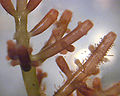 Archaeplastida
 -
 Archaeplastida
 -
 Archaeplastida
 -
 Archaeplastida
 -
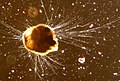 Archaeplastida
 -
Archaeplastida
-
Archaeplastida
-
Archaeplastida
-
Archaeplastida
-
Archaeplastida
_(klaDA0073).jpg)


.jpg)


.png)