Carrageenan
Carrageenan is a family of linear sulfated polysaccharides that are extracted from red edible seaweeds. They are widely used in the food industry, for their gelling, thickening, and stabilizing properties. The name "carrageenan" is derived from a type of seaweed that is abundant along the Irish coastline, known as "carrageen moss" or Irish moss in England, and "carraigín" in Ireland.
Types and Uses[edit]
There are three main varieties of carrageenan, which differ in their degree of sulfation and hence, in their chemical properties. These are kappa (κ), iota (ι), and lambda (λ) carrageenan. Kappa-carrageenan has one sulfate group per disaccharide, iota-carrageenan has two, and lambda-carrageenan has three.
- Kappa-carrageenan creates strong, rigid gels in the presence of potassium ions, making it useful in dairy products and meat products.
- Iota-carrageenan forms soft gels in the presence of calcium ions. It is used in the food industry to improve the texture of products such as ice cream, jelly, and pudding.
- Lambda-carrageenan does not gel but is used to thicken dairy products.
The use of carrageenan in food products is regulated by health authorities such as the Food and Drug Administration (FDA) in the United States and the European Food Safety Authority (EFSA) in the European Union.
Health Concerns[edit]
The safety of carrageenan has been a topic of debate. While food-grade carrageenan is considered safe by the FDA and EFSA, degraded carrageenan, also known as poligeenan, is not. Poligeenan is produced by hydrolyzing carrageenan under strong acidic conditions, leading to a lower molecular weight and different chemical properties. Poligeenan is not used in food products, as it does not have the thickening or gelling properties of food-grade carrageenan.
Some animal studies have suggested that food-grade carrageenan may contribute to gastrointestinal inflammation and higher rates of intestinal lesions, ulcerations, and even tumors. However, these findings have not been consistently replicated in human studies. The International Agency for Research on Cancer (IARC), a part of the World Health Organization (WHO), has classified degraded carrageenan as a possible human carcinogen but has not listed food-grade carrageenan in this category.
Environmental Impact[edit]
The production of carrageenan can have environmental impacts, particularly concerning the sustainability of red seaweed farming. Overharvesting of wild seaweed stocks can lead to habitat destruction and a decrease in biodiversity. However, the cultivation of red seaweed for carrageenan production can be done sustainably, and efforts are being made to improve farming practices to minimize environmental impact.
Conclusion[edit]
Carrageenan is a versatile ingredient used in various food products for its gelling, thickening, and stabilizing properties. While there are some health concerns associated with its consumption, food-grade carrageenan is considered safe by major health authorities. Sustainable farming practices are crucial for minimizing the environmental impact of carrageenan production.

-
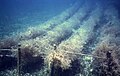 Eucheuma farming in the Philippines
 -
 Molecular structure of different carrageenan types
 -
 Eucheuma denticulatum in an off-bottom cultivation, Bweleo, Zanzibar
.jpg)


Medical Disclaimer: WikiMD is for informational purposes only and is not a substitute for professional medical advice. Content may be inaccurate or outdated and should not be used for diagnosis or treatment. Always consult your healthcare provider for medical decisions. Verify information with trusted sources such as CDC.gov and NIH.gov. By using this site, you agree that WikiMD is not liable for any outcomes related to its content. See full disclaimer.
Credits:Most images are courtesy of Wikimedia commons, and templates, categories Wikipedia, licensed under CC BY SA or similar.
Translate page: - East Asian
中文,
日本,
한국어,
South Asian
हिन्दी,
தமிழ்,
తెలుగు,
Urdu,
ಕನ್ನಡ,
Southeast Asian
Indonesian,
Vietnamese,
Thai,
မြန်မာဘာသာ,
বাংলা
European
español,
Deutsch,
français,
Greek,
português do Brasil,
polski,
română,
русский,
Nederlands,
norsk,
svenska,
suomi,
Italian
Middle Eastern & African
عربى,
Turkish,
Persian,
Hebrew,
Afrikaans,
isiZulu,
Kiswahili,
Other
Bulgarian,
Hungarian,
Czech,
Swedish,
മലയാളം,
मराठी,
ਪੰਜਾਬੀ,
ગુજરાતી,
Portuguese,
Ukrainian

