Lapachol: Difference between revisions
CSV import |
CSV import |
||
| Line 23: | Line 23: | ||
{{medicine-stub}} | {{medicine-stub}} | ||
{{No image}} | {{No image}} | ||
<gallery> | |||
File:Lapachol_molecule_ball.png|Lapachol molecule ball | |||
</gallery> | |||
Revision as of 00:35, 27 February 2025

Lapachol is a natural phenolic compound found in the wood of trees belonging to the Bignoniaceae family, notably in the Tabebuia genus, which is native to the Americas. This compound has attracted interest due to its potential medicinal properties, including anti-inflammatory, antifungal, and antitumor activities. The chemical structure of lapachol allows it to interact with various biological targets, contributing to its diverse pharmacological effects.
Chemistry
Lapachol, with the chemical formula C15H14O3, is classified as a naphthoquinone. Its structure consists of a naphthalene ring bonded to a quinone moiety, which is responsible for its biological activity. The compound is poorly soluble in water but can be extracted from wood using organic solvents.
Biological Activities
Lapachol has been studied for its range of biological activities. Its antioxidant properties are attributed to its ability to scavenge free radicals, thereby reducing oxidative stress in cells. The compound's antifungal activity makes it a potential treatment for fungal infections, while its anti-inflammatory effects could be beneficial in managing conditions characterized by inflammation.
One of the most significant areas of research is lapachol's anticancer potential. It has been shown to inhibit the growth of certain cancer cells in vitro and in vivo, though its mechanism of action is still under investigation. It is believed that lapachol interferes with DNA synthesis and cell division, leading to cell death in cancerous cells.
Safety and Toxicity
While lapachol has demonstrated promising medicinal properties, its safety and toxicity profile is a concern. Studies have shown that high doses of lapachol can be toxic, causing adverse effects such as nausea, vomiting, and even hematological disorders. As a result, further research is needed to fully understand its pharmacokinetics and to develop safe, effective dosing regimens for therapeutic use.
Current Research and Applications
Research on lapachol is ongoing, with scientists exploring its potential applications in medicine, particularly in the treatment of cancer and infectious diseases. However, its use in clinical settings is limited by the need for more comprehensive studies to establish its efficacy and safety.
Conclusion
Lapachol remains a compound of interest due to its diverse pharmacological activities and potential therapeutic applications. Continued research is essential to unlock its full potential and to overcome the challenges related to its toxicity and solubility.

-
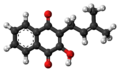 Lapachol molecule ball

