Topical gels: Difference between revisions
CSV import |
CSV import |
||
| Line 72: | Line 72: | ||
[[Category:Dermatology]] | [[Category:Dermatology]] | ||
[[Category:Drug delivery devices]] | [[Category:Drug delivery devices]] | ||
<gallery caption="Topical_gels"> | |||
File:Colloid_gel.svg|Colloid gel | |||
File:Hydrogel-Wundauflage.jpg|Hydrogel wound dressing | |||
File:Skin.png|Skin | |||
File:Cluster_bean-guar-Cyamopsis_psoralioides-Cyamopsis_tetragonolobus-TAMIL_NADU73.jpg|Cluster bean (guar) | |||
File:Sorbitol.png|Sorbitol | |||
File:SKLEER_Natural_Skin_Restoration_Gel_2.5oz_Carton_Tube.jpg|SKLEER Natural Skin Restoration Gel | |||
File:Benadryl_Itch_Stopping_Gel_(4600729217).jpg|Benadryl Itch Stopping Gel | |||
File:Salting_In_-_Salting_Out.png|Salting In - Salting Out | |||
</gallery> | |||
Latest revision as of 12:17, 18 February 2025
Topical Gels[edit]

A topical gel is a type of semisolid formulation that is applied to the skin or mucous membranes. These gels are used for delivering active ingredients directly to the site of action or for systemic absorption. They are composed of a three-dimensional network of polymer chains that are capable of retaining a significant amount of water or other solvents.
Composition[edit]
Topical gels typically consist of a gelling agent, a solvent, and an active ingredient. Common gelling agents include carbomer, xanthan gum, and guar gum.

The solvent is usually water or alcohol, which helps in the dissolution of the active ingredient and provides a cooling effect upon application. The active ingredient can vary widely depending on the intended use of the gel, ranging from analgesics and anti-inflammatory agents to antibiotics and antifungals.
Types of Topical Gels[edit]
Hydrogel[edit]

A hydrogel is a type of gel that contains a high percentage of water. Hydrogels are often used in wound care and burn treatment due to their ability to provide a moist environment that promotes healing.
Alcohol-Based Gels[edit]
Alcohol-based gels are commonly used for antiseptic purposes, such as hand sanitizers. These gels evaporate quickly, leaving the skin feeling refreshed and clean.
Oil-Based Gels[edit]
Oil-based gels are used for their emollient properties, providing a barrier that helps to retain moisture in the skin. They are often used in cosmetic and dermatological applications.
Applications[edit]
Topical gels are used in a variety of applications, including:
- Pain relief: Gels containing menthol or capsaicin are used for relieving muscle and joint pain.
- Allergy treatment: Gels with diphenhydramine are used to relieve itching and irritation from allergic reactions.
.jpg)
- Acne treatment: Gels containing benzoyl peroxide or salicylic acid are used to treat acne.
- Moisturization: Gels with hyaluronic acid are used to hydrate and plump the skin.
Mechanism of Action[edit]
Topical gels work by delivering the active ingredient directly to the site of action. The gel matrix allows for controlled release of the active ingredient, providing sustained effects over time. The viscosity of the gel can be adjusted to control the rate of release and absorption.
Advantages and Disadvantages[edit]
Advantages[edit]
- Easy to apply and spread over large areas.
- Non-greasy and quickly absorbed by the skin.
- Can provide localized treatment with minimal systemic side effects.
Disadvantages[edit]
- May cause skin irritation or allergic reactions in sensitive individuals.
- Some gels may leave a sticky residue on the skin.
Related Pages[edit]
References[edit]
<references group="" responsive="1"></references>
- Topical_gels
-
 Colloid gel
 -
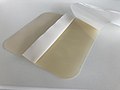 Hydrogel wound dressing
 -
 Skin
Skin -
 Cluster bean (guar)
 -
 Sorbitol
 -
 SKLEER Natural Skin Restoration Gel
 -
 Benadryl Itch Stopping Gel
 -
 Salting In - Salting Out


