Transmembrane protein: Difference between revisions
CSV import |
CSV import |
||
| Line 49: | Line 49: | ||
[[Category:Membrane proteins]] | [[Category:Membrane proteins]] | ||
<gallery> | |||
File:Polytopic_membrane_protein.png|Polytopic membrane protein | |||
File:Group_1_and_2_transmembrane_protein.png|Group 1 and 2 transmembrane protein | |||
File:Cumulative_Unique_Membrane_Protein_Structures_by_Year.png|Cumulative unique membrane protein structures by year | |||
</gallery> | |||
Latest revision as of 04:16, 18 February 2025
Transmembrane Protein[edit]

A transmembrane protein is a type of integral membrane protein that spans the entirety of the biological membrane to which it is permanently attached. These proteins are crucial for a variety of cellular processes, including signaling, transport, and maintaining the structure of the cell.
Structure[edit]
Transmembrane proteins typically have one or more alpha-helical segments that traverse the lipid bilayer. These segments are composed of hydrophobic amino acids that interact with the lipid tails of the membrane. Some transmembrane proteins may also contain beta-barrel structures, which are more common in the outer membranes of gram-negative bacteria, mitochondria, and chloroplasts.

Function[edit]
Transmembrane proteins serve a variety of functions:
- Transport: They act as channels or carriers for molecules to pass through the membrane. Examples include ion channels and transporters.
- Signal Transduction: They play a role in transmitting signals from the outside to the inside of the cell, often involving receptors that bind to specific ligands.
- Cell Adhesion: Some transmembrane proteins are involved in cell-cell adhesion, helping cells to stick to each other and to the extracellular matrix.
- Enzymatic Activity: Certain transmembrane proteins have enzymatic functions, catalyzing reactions at the membrane surface.
Types[edit]
Transmembrane proteins can be classified based on their topology and the number of times they span the membrane:
- Single-pass transmembrane proteins: These proteins cross the membrane only once.
- Multi-pass transmembrane proteins: These proteins have multiple segments that cross the membrane several times, often forming complex structures.
Synthesis and Insertion[edit]
The synthesis of transmembrane proteins occurs in the endoplasmic reticulum (ER). They are initially synthesized as polypeptide chains by ribosomes and then inserted into the ER membrane. The insertion process is facilitated by the translocon, a complex that helps guide the protein into the membrane.
Research and Applications[edit]
Transmembrane proteins are a major focus of research due to their roles in health and disease. They are targets for many drugs and are studied for their potential in biotechnology and nanotechnology.

Related Pages[edit]
References[edit]
<references group="" responsive="1"></references>
-
 Polytopic membrane protein
 -
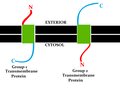 Group 1 and 2 transmembrane protein
 -
 Cumulative unique membrane protein structures by year
