Spanish conquest of the Inca Empire: Difference between revisions
CSV import |
CSV import |
||
| Line 54: | Line 54: | ||
[[Category:Conflicts in 1532]] | [[Category:Conflicts in 1532]] | ||
[[Category:Conflicts in 1572]] | [[Category:Conflicts in 1572]] | ||
<gallery> | |||
File:Montaje 2 conquista del Peru.png|Montaje 2 conquista del Peru | |||
File:Diego de Almagro.JPG|Diego de Almagro | |||
File:Conquest peru 1531.jpg|Conquest Peru 1531 | |||
File:Portrait of Francisco Pizarro.jpg|Portrait of Francisco Pizarro | |||
File:Atawallpa Pizarro tinkuy.jpg|Atawallpa Pizarro tinkuy | |||
File:Inca-Spanish confrontation.JPG|Inca-Spanish confrontation | |||
File:Luis Montero - The Funerals of Inca Atahualpa - Google Art Project.jpg|The Funerals of Inca Atahualpa | |||
File:Tupaq amarup umanta kuchunku.gif|Tupaq amarup umanta kuchunku | |||
File:Francisco Pizarro ante Carlos V.jpg|Francisco Pizarro ante Carlos V | |||
File:Pizarro in Lima.JPG|Pizarro in Lima | |||
</gallery> | |||
Latest revision as of 06:17, 3 March 2025
Spanish conquest of the Inca Empire
The Spanish conquest of the Inca Empire was one of the most significant events in the Spanish colonization of the Americas. It led to the fall of the Inca Empire and the establishment of Spanish rule over much of South America.
Background[edit]
The Inca Empire, known as Tawantinsuyu in the Quechua language, was the largest empire in pre-Columbian America. It was centered in the Andes Mountains and included parts of present-day Peru, Ecuador, Bolivia, Colombia, Chile, and Argentina.
The empire was highly organized, with a complex administrative system and a network of roads and bridges. The Incas were skilled in agriculture, architecture, and engineering.
Spanish Arrival[edit]
In 1532, Francisco Pizarro and his expedition arrived in the Inca territory. At that time, the Inca Empire was weakened by a civil war between the brothers Atahualpa and Huáscar, who were fighting for the throne.
Pizarro took advantage of this internal conflict and captured Atahualpa during the Battle of Cajamarca. Despite paying a large ransom in gold and silver, Atahualpa was executed by the Spanish.
Conquest and Aftermath[edit]
Following Atahualpa's death, the Spanish continued their conquest, capturing the Inca capital of Cusco in 1533. The conquest was facilitated by the superior military technology of the Spanish, including firearms and horses, as well as alliances with local tribes who were enemies of the Incas.
The last Inca stronghold, the city of Vilcabamba, fell to the Spanish in 1572, marking the end of the Inca Empire. The Spanish established the Viceroyalty of Peru, which became a major center of Spanish colonial power in the Americas.
Legacy[edit]
The Spanish conquest had a profound impact on the indigenous peoples of the region. It led to the collapse of the Inca political and social structures, the spread of European diseases to which the native population had no immunity, and the imposition of Spanish culture and Catholicism.
The conquest also resulted in the transfer of vast amounts of wealth from the Americas to Spain, contributing to the Spanish Golden Age.
See also[edit]
References[edit]
- John Hemming, The Conquest of the Incas
- Pedro Cieza de León, The Incas of Pedro de Cieza de León

-
 Montaje 2 conquista del Peru
 -
 Diego de Almagro
 -
 Conquest Peru 1531
 -
 Portrait of Francisco Pizarro
 -
 Atawallpa Pizarro tinkuy
 -
 Inca-Spanish confrontation
 -
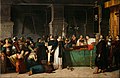 The Funerals of Inca Atahualpa
 -
 Tupaq amarup umanta kuchunku
 -
 Francisco Pizarro ante Carlos V
 -
Pizarro in Lima


