Zealand: Difference between revisions
CSV import |
CSV import |
||
| Line 25: | Line 25: | ||
[[Category:Islands of Denmark]] | [[Category:Islands of Denmark]] | ||
[[Category:Geography of Denmark]] | [[Category:Geography of Denmark]] | ||
== Zealand == | |||
<gallery> | |||
File:Stevns Klint Juli 2019.jpg|Stevns Klint | |||
File:Denmark location sjalland.svg|Location of Zealand in Denmark | |||
File:Gefion.jpg|Gefion Fountain | |||
File:Belte inter.png|Belt Bridge | |||
</gallery> | |||
Latest revision as of 01:08, 20 February 2025


Zealand (Danish: Sjælland), is the largest and most populous island in Denmark, situated between the Island of Funen (Fyn) and the southern tip of Sweden. It is connected to Funen by the Great Belt Bridge and to Sweden by the Øresund Bridge. Zealand is home to the Danish capital, Copenhagen, which is located on the eastern shore of the island.
Geography[edit]
Zealand is characterized by a varied landscape that includes coastal cliffs, sandy beaches, and rolling hills. The island covers an area of approximately 7,031 square kilometers, making it the largest island in Denmark. The highest point on Zealand is Gyldenløveshøj, with an elevation of 126 meters above sea level. Zealand is surrounded by several bodies of water, including the Baltic Sea to the southeast and the North Sea to the west. The island's significant bodies of water include the Isefjord and the Roskilde Fjord.
History[edit]
The history of Zealand dates back to the Viking Age, when it served as a significant center of power and trade. In the medieval period, Zealand played a crucial role in the establishment of the Danish nation-state, with the construction of Roskilde Cathedral, a key landmark and the burial site of Danish monarchs. The island has been the focal point of many historical events in Denmark, including battles, royal residences, and the development of Copenhagen into a significant European capital.
Economy[edit]
Zealand's economy is diverse, with a strong emphasis on services, trade, and industry. Copenhagen, as the economic hub of the island, hosts a wide range of businesses and institutions, including the Copenhagen Stock Exchange. The region around Copenhagen is known for its high-tech industry, pharmaceutical companies, and research institutions. Agriculture also plays a significant role in Zealand's economy, with the island producing a substantial portion of Denmark's food products.
Culture[edit]
Zealand is a cultural powerhouse, not only because it is home to Copenhagen, Denmark's capital, but also due to its rich history, architecture, and arts. The island boasts numerous museums, galleries, and theaters, including the National Museum of Denmark and the Royal Danish Theatre. Zealand is also known for its festivals, culinary scene, and design. The Danish concept of hygge, often associated with coziness and contentment, is deeply ingrained in Zealand's lifestyle.
Transportation[edit]
Transportation in Zealand is well-developed, with a network of roads, bridges, and railways connecting the island to the rest of Denmark and to Sweden. The Øresund Bridge is a notable engineering feat that links Zealand to Sweden, facilitating the flow of people and goods between the two countries. Public transportation within Zealand is comprehensive, including buses, trains, and the Copenhagen Metro.
See also[edit]
Zealand[edit]
-
 Stevns Klint
 -
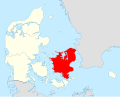 Location of Zealand in Denmark
 -
 Gefion Fountain
 -
 Belt Bridge

