Pineal gland cyst: Difference between revisions
CSV import |
CSV import |
||
| Line 29: | Line 29: | ||
{{medicine-stub}} | {{medicine-stub}} | ||
<gallery> | |||
File:Verkalkte Corpus pineale Zyste sagittal.jpg|Pineal gland cyst | |||
File:Microsurgical resection of a pineal cyst.webm|Pineal gland cyst | |||
File:Brain MRI 0037 10.jpg|Pineal gland cyst | |||
File:Pinealiszyste 32jw - MRT T2 sag - Annotation - 001.jpg|Pineal gland cyst | |||
</gallery> | |||
Revision as of 01:23, 20 February 2025
Pineal Gland Cyst is a benign (non-cancerous) cyst located in the pineal gland, a small endocrine gland in the brain. The pineal gland produces melatonin, a hormone that plays a crucial role in regulating sleep patterns and circadian rhythms. Pineal gland cysts are typically discovered incidentally during magnetic resonance imaging (MRI) scans conducted for other reasons, as they often do not cause symptoms.
Symptoms
In most cases, pineal gland cysts are asymptomatic and do not affect the gland's function or lead to health issues. However, in rare instances, large cysts may cause symptoms due to pressure on adjacent structures in the brain. These symptoms can include:
- Headaches
- Visual disturbances
- Vertigo or dizziness
- Sleep disturbances
- Hydrocephalus (accumulation of fluid in the brain), in very rare cases
Diagnosis
Pineal gland cysts are usually diagnosed through brain imaging techniques, with MRI being the most detailed method to visualize the cyst's size, shape, and exact location. Computed tomography (CT) scans may also be used but are less detailed than MRIs.
Treatment
Treatment for pineal gland cysts is often not necessary unless the cyst is large and causes symptoms. In such cases, treatment options may include:
- Monitoring with regular MRI scans to check for changes in the size of the cyst
- Medication to manage symptoms such as headaches or dizziness
- Surgical removal of the cyst, in rare cases where it causes significant symptoms or hydrocephalus
Prognosis
The prognosis for individuals with pineal gland cysts is generally excellent, as these cysts are benign and rarely cause symptoms or require treatment. Regular monitoring is recommended to ensure that the cyst does not grow significantly.
Epidemiology
Pineal gland cysts are relatively common, with studies suggesting that they are present in 1.5% to 10.8% of the general population. They are more frequently diagnosed in young adults and are slightly more common in females than in males.

-
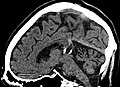 Pineal gland cyst
 -
 Pineal gland cyst
 -
 Pineal gland cyst
 -
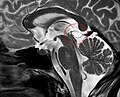 Pineal gland cyst


