Associative visual agnosia: Difference between revisions
CSV import |
CSV import |
||
| Line 27: | Line 27: | ||
{{Neuro-stub}} | {{Neuro-stub}} | ||
<gallery> | |||
File:Lobes_of_the_brain.jpg|Lobes of the brain | |||
File:Ventral-dorsal_streams.svg|Ventral and dorsal streams | |||
File:Object_Recognition_Model.png|Object recognition model | |||
File:Banana-fluorescence-081108.jpg|Associative visual agnosia | |||
File:Flowchart_for_Assessment_of_Visual_Agnosias.png|Flowchart for assessment of visual agnosias | |||
</gallery> | |||
Revision as of 04:30, 18 February 2025
Associative Visual Agnosia is a neurological disorder characterized by the inability to recognize objects despite having the ability to see and describe them. This condition arises from damage to the brain areas involved in the complex process of object recognition, particularly the areas responsible for associating visual information with semantic information from memory. Patients with associative visual agnosia can often describe the features of an object (e.g., color, shape) but fail to identify the object itself or its purpose.
Causes
Associative visual agnosia is most commonly caused by cerebral infarctions, traumatic brain injuries, or other neurological conditions that affect the temporal lobe or the occipitotemporal region of the brain. These areas are crucial for linking visual perception with the memory of objects, their names, and their uses.
Symptoms
The primary symptom of associative visual agnosia is the inability to recognize visually presented objects. Patients might be able to describe an object's physical attributes, such as its color and shape, but cannot identify the object or its significance. For example, a person with this condition might be able to describe a key as a metal object with teeth but may not be able to say that it is a key or explain its use. Despite this, individuals with associative visual agnosia typically have intact visual acuity and can often still recognize objects through other senses, such as touch.
Diagnosis
Diagnosis of associative visual agnosia involves a comprehensive assessment that includes neuropsychological testing, brain imaging techniques like MRI or CT scans, and a thorough medical history. Tests are designed to evaluate the patient's object recognition abilities, memory, and other cognitive functions to differentiate associative visual agnosia from other types of agnosia or cognitive disorders.
Treatment
There is no cure for associative visual agnosia, but treatment focuses on managing symptoms and improving the patient's quality of life. Rehabilitation strategies may include occupational therapy to help individuals learn alternative strategies for object recognition and coping mechanisms for daily living. Cognitive therapy may also be beneficial in helping patients develop compensatory strategies.
Prognosis
The prognosis for associative visual agnosia varies depending on the underlying cause of the condition and the extent of brain damage. Some patients may experience improvement over time, especially with rehabilitation and therapy, while others may have persistent difficulties.
See Also

This article is a neuroscience stub. You can help WikiMD by expanding it!
-
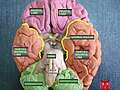 Lobes of the brain
 -
 Ventral and dorsal streams
 -
 Object recognition model
 -
 Associative visual agnosia
 -
 Flowchart for assessment of visual agnosias


