Biological determinism: Difference between revisions
CSV import Tags: mobile edit mobile web edit |
CSV import |
||
| Line 34: | Line 34: | ||
{{Genetics-stub}} | {{Genetics-stub}} | ||
{{medicine-stub}} | {{medicine-stub}} | ||
==Biological determinism== | |||
<gallery> | |||
File:Weismann's Germ Plasm.svg|Weismann's Germ Plasm | |||
File:Francis Galton 1850s.jpg|Francis Galton 1850s | |||
File:Plos wilson.jpg|Plos Wilson | |||
</gallery> | |||
Latest revision as of 01:49, 20 February 2025
Biological determinism, also known as genetic determinism, is the belief that human behavior and characteristics are solely determined by biological factors, such as genetics and heredity, rather than environmental or social influences. This concept has been a subject of debate within the scientific community and has implications across various fields, including psychology, sociology, and anthropology.
Overview[edit]
Biological determinism posits that the genes a person inherits from their parents dictate their physical traits, personality, intelligence, and even social behaviors. Proponents argue that biological factors provide a concrete explanation for human behavior and characteristics, often using studies from genetics and neuroscience to support their claims.
History[edit]
The roots of biological determinism can be traced back to the 19th century, with notable figures such as Francis Galton, who introduced the idea of eugenics, advocating for the improvement of the human race through selective breeding. Over time, the concept has evolved, incorporating modern genetic research and findings from the Human Genome Project.
Criticism[edit]
Biological determinism has faced significant criticism for oversimplifying the complex interplay between genetics and environment. Critics argue that it ignores the role of culture, education, and personal experiences in shaping an individual. Furthermore, it has been associated with controversial ideologies, such as racism and sexism, by suggesting that certain genetic traits inherent to particular groups determine intelligence or behavior.
Ethical and Social Implications[edit]
The debate over biological determinism has ethical and social implications, particularly in discussions about free will, responsibility, and equality. It raises questions about the extent to which individuals can be held accountable for their actions if those actions are predetermined by their biology. Additionally, it challenges the notion of equal opportunity, suggesting that inherent biological differences may limit an individual's potential.
Related Fields[edit]
- Genetics: The study of heredity and the variation of inherited characteristics.
- Neuroscience: The scientific study of the nervous system, particularly focusing on how biological processes affect behavior and cognition.
- Psychology: The scientific study of the mind and behavior, examining the influence of both genetic and environmental factors.
- Sociology: The study of social behavior and society, including the examination of the social and environmental influences on behavior and personality.
See Also[edit]

This article is a philosophy-related stub. You can help WikiMD by expanding it!


Biological determinism[edit]
-
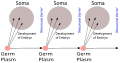 Weismann's Germ Plasm
 -
 Francis Galton 1850s
 -
 Plos Wilson


