Margin of error: Difference between revisions
CSV import Tags: mobile edit mobile web edit |
CSV import |
||
| Line 40: | Line 40: | ||
{{Statistics-stub}} | {{Statistics-stub}} | ||
<gallery> | |||
File:Margin-of-error-95.svg|Margin of error at 95% confidence level | |||
File:Empirical_Rule.PNG|Empirical Rule | |||
File:Margin_of_error_vs_sample_size_and_confidence_level.svg|Margin of error vs sample size and confidence level | |||
</gallery> | |||
Latest revision as of 03:53, 18 February 2025
Margin of Error is a statistical term used to describe the amount of uncertainty in a sample estimate of a population parameter. The concept is crucial in survey sampling, experimental design, and many other areas of statistics and research methodology to quantify the potential difference between the observed sample estimate and the true population parameter. Understanding the margin of error is essential for interpreting the reliability and precision of study results, especially in fields such as medicine, political polling, and market research.
Definition[edit]
The margin of error (MOE) represents the radius of an interval around a sample statistic. For example, in polling data, if a candidate has 50% support with a margin of error of 4%, it means that the true level of support is likely between 46% and 54%. The MOE is typically associated with a confidence level, often set at 95%, which quantifies the probability that the interval contains the true parameter.
Calculation[edit]
The calculation of the margin of error depends on the sample size, the standard deviation of the population (or an estimate of it from the sample), and the desired confidence level. For a simple random sample from a large population, the formula for the MOE of a proportion is given by:
\[ MOE = Z \times \sqrt{\frac{p(1-p)}{n}} \]
where:
- \(Z\) is the Z-score associated with the desired confidence level (e.g., 1.96 for 95% confidence),
- \(p\) is the sample proportion, and
- \(n\) is the sample size.
For means, the formula adjusts to account for the sample standard deviation (\(s\)) instead of \(p(1-p)\):
\[ MOE = Z \times \frac{s}{\sqrt{n}} \]
Factors Affecting the Margin of Error[edit]
Several factors influence the size of the margin of error:
- Sample Size: Increasing the sample size decreases the MOE, improving the estimate's precision.
- Population Variability: More variability in the population increases the MOE.
- Confidence Level: Higher confidence levels lead to a larger Z-score and, consequently, a larger MOE.
Interpretation[edit]
A smaller margin of error indicates a more precise estimate of the population parameter. However, it is important to note that the MOE only accounts for sampling error and not for other types of errors, such as measurement error or non-sampling error (e.g., nonresponse bias).
Applications[edit]
Margin of error is widely used in various fields:
- In political polling, it helps in understanding the uncertainty in the level of support for candidates or issues.
- In medical research, it assists in interpreting the reliability of estimates from clinical trials or epidemiological studies.
- In market research, it quantifies the precision of estimates regarding consumer behavior or preferences.
Limitations[edit]
While the margin of error is a useful measure of sampling variability, it does not encompass all sources of error in survey research, such as nonresponse bias, question wording effects, or data processing errors. Therefore, it should be interpreted within the context of the study's overall quality and design.

This article is a statistics-related stub. You can help WikiMD by expanding it!
-
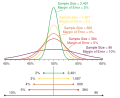 Margin of error at 95% confidence level
 -
 Empirical Rule
 -
 Margin of error vs sample size and confidence level


