Pediatric podiatry: Difference between revisions
CSV import |
CSV import |
||
| Line 29: | Line 29: | ||
{{anatomy-stub}} | {{anatomy-stub}} | ||
<gallery> | |||
File:Stride_rite_sneakers_10101.jpeg|Stride Rite Sneakers | |||
File:children_foot.jpg|Children's Foot | |||
File:children_flatfeet.jpg|Children with Flat Feet | |||
</gallery> | |||
Latest revision as of 02:05, 18 February 2025
Pediatric Podiatry is a specialized branch of podiatry that focuses on the diagnosis, treatment, and prevention of foot and lower limb conditions in children. This field of medicine is crucial as the feet of children are still growing and developing, and any abnormalities or issues can have long-term effects on their overall health and mobility.
Overview[edit]
Pediatric podiatrists are healthcare professionals who have undergone additional training to understand the unique needs and challenges of treating children. They are skilled in recognizing and treating a wide range of conditions, from common foot problems such as ingrown toenails and plantar warts, to more complex issues like flat feet, in-toeing, and clubfoot.
Common Conditions[edit]
Children can experience a variety of foot and lower limb conditions. Some of the most common include:
- Flat Feet: This is a common condition where the arches on the inside of the feet are flattened, allowing the entire soles of the feet to touch the floor when standing.
- In-toeing: Also known as "pigeon toes," this condition is characterized by the inward turning of the feet when walking or running.
- Clubfoot: This is a birth defect where one or both of a baby's feet are rotated inward and downward.
- Ingrown Toenails: This occurs when the edges or corners of nails grow into the skin next to the nail.
- Plantar Warts: These are small growths that usually appear on the heels or other weight-bearing areas of the feet.
Treatment[edit]
Treatment in pediatric podiatry varies depending on the condition and its severity. Non-surgical treatments such as orthotics, physical therapy, and medication are often first-line treatments. In more severe cases, surgical intervention may be necessary.
See Also[edit]
References[edit]
<references />

-
 Stride Rite Sneakers
 -
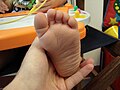 Children's Foot
 -
 Children with Flat Feet


