Steroid hydroxylase: Difference between revisions
CSV import |
CSV import |
||
| Line 31: | Line 31: | ||
[[Category:Endocrinology]] | [[Category:Endocrinology]] | ||
{{pharmacology-stub}} | {{pharmacology-stub}} | ||
<gallery> | |||
File:Corticosteroid-biosynthetic-pathway-rat.png|Corticosteroid biosynthetic pathway in rats | |||
File:Steroidogenesis.svg|Steroidogenesis pathway | |||
File:Steroid_numbering.svg|Steroid numbering system | |||
File:DHEA1.svg|Steroid hydroxylase | |||
</gallery> | |||
Latest revision as of 04:31, 18 February 2025
Steroid hydroxylase is a type of enzyme that plays a crucial role in the metabolism of steroids. It is responsible for the hydroxylation of steroids, a chemical process that introduces a hydroxyl group (-OH) into the steroid molecule. This process is essential for the biological activity of steroids, as it allows them to be converted into their active forms.
Function[edit]
Steroid hydroxylase enzymes are involved in the biosynthesis of corticosteroids, glucocorticoids, mineralocorticoids, and sex steroids. They catalyze the addition of a hydroxyl group to specific carbon atoms in the steroid molecule. This hydroxylation process is a key step in the activation of steroids, as it enables them to bind to their respective steroid receptors and exert their biological effects.
Types[edit]
There are several types of steroid hydroxylase enzymes, each of which hydroxylates a specific position on the steroid molecule. These include:
- 17α-hydroxylase: This enzyme is involved in the biosynthesis of glucocorticoids and sex steroids. It hydroxylates the 17th carbon atom of the steroid molecule.
- 21-hydroxylase: This enzyme is crucial for the production of mineralocorticoids and glucocorticoids. It hydroxylates the 21st carbon atom of the steroid molecule.
- 11β-hydroxylase: This enzyme is involved in the final steps of corticosteroid synthesis. It hydroxylates the 11th carbon atom of the steroid molecule.
Clinical significance[edit]
Deficiencies in steroid hydroxylase enzymes can lead to various medical conditions. For example, a deficiency in 21-hydroxylase can cause congenital adrenal hyperplasia, a group of inherited disorders that affect the adrenal glands. Similarly, a deficiency in 11β-hydroxylase can lead to a form of congenital adrenal hyperplasia characterized by hypertension and virilization.
See also[edit]
References[edit]
<references group="" responsive="1"></references>

-
 Corticosteroid biosynthetic pathway in rats
 -
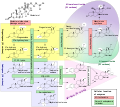 Steroidogenesis pathway
 -
 Steroid numbering system
 -
 Steroid hydroxylase


