Cello: Difference between revisions
CSV import Tags: mobile edit mobile web edit |
CSV import |
||
| Line 29: | Line 29: | ||
{{Music-stub}} | {{Music-stub}} | ||
<gallery> | |||
File:Cello_front_side.png|Cello front side | |||
File:Range_cello.png|Range cello | |||
File:Cello_study.jpg|Cello study | |||
File:Violoncello_open_strings.png|Violoncello open strings | |||
File:Cello_and_a_bow.jpg|Cello and a bow | |||
File:Cello_strung_gut.JPG|Cello strung gut | |||
File:Josephine_van_Lier_plays_violoncello_piccolo.jpg|Josephine van Lier plays violoncello piccolo | |||
File:20091104_Alisa_Weilerstein_and_Sujari_Britt_-_Boccherini's_Sonata_for_Two_Cellos_in_C_Major,_1st_movement_Allegro_moderato.theora.ogv|Alisa Weilerstein and Sujari Britt - Boccherini's Sonata for Two Cellos in C Major, 1st movement Allegro moderato | |||
File:FHM-Orchestra-mk2006-03.jpg|FHM Orchestra | |||
File:Apocalyptica_-_Ilosaarirock_2009.jpg|Apocalyptica - Ilosaarirock 2009 | |||
File:Cello_Parts.jpg|Cello Parts | |||
</gallery> | |||
Latest revision as of 21:00, 23 February 2025
Cello
The Cello or Violoncello is a string instrument that belongs to the violin family, which also includes the violin and viola. It is played by drawing a bow across its four strings, which are tuned in perfect fifths. The cello is known for its rich, warm tone and its ability to play a wide range of musical roles, from melody to harmony to rhythm.
History[edit]
The cello was developed in the 16th century, as a direct descendant of the bass violin. The first cellos were larger than the modern cello and had a less standardized shape. Over time, the design of the cello evolved to its current form, which is smaller and more standardized.
Construction[edit]
The cello is typically made of wood, with a hollow body that serves as a resonating chamber. The top and back of the cello are traditionally made of different types of wood: the top is usually made of spruce, while the back is typically made of maple. The cello's neck and scroll are usually made of maple as well.
Playing technique[edit]
Playing the cello involves a combination of different techniques, including bowing, plucking, and fingering. The player holds the cello between their knees and draws the bow across the strings to produce sound. The left hand is used to change the pitch of the notes by pressing down on the strings.
Repertoire and use in music[edit]
The cello has a vast repertoire, which spans from the Baroque era to the present day. It is used in a variety of musical genres, including classical music, jazz, folk music, and rock music. In addition to its use as a solo instrument, the cello is also a key component of orchestras, string quartets, and other types of chamber music ensembles.
See also[edit]

-
 Cello front side
 -
 Range cello
 -
 Cello study
 -
 Violoncello open strings
 -
 Cello and a bow
 -
 Cello strung gut
 -
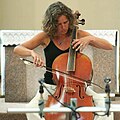 Josephine van Lier plays violoncello piccolo
 -
 Alisa Weilerstein and Sujari Britt - Boccherini's Sonata for Two Cellos in C Major, 1st movement Allegro moderato
 -
 FHM Orchestra
 -
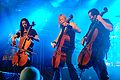 Apocalyptica - Ilosaarirock 2009
 -
 Cello Parts


