Cogeneration: Difference between revisions
CSV import |
CSV import |
||
| Line 37: | Line 37: | ||
[[Category:Sustainable energy]] | [[Category:Sustainable energy]] | ||
{{Energy-stub}} | {{Energy-stub}} | ||
<gallery> | |||
File:Cogeneration.png|Cogeneration | |||
File:Masnedø_power_station.jpg|Masnedø Power Station | |||
File:Metz_biomass_power_station.jpg|Metz Biomass Power Station | |||
File:Rostock_Power_Station,_SW_view.jpg|Rostock Power Station, SW view | |||
File:Hanasaari_B.jpg|Hanasaari B | |||
File:Trigeneration_Cycle.jpg|Trigeneration Cycle | |||
File:Power_plant_at_sunset.jpg|Power plant at sunset | |||
File:Mirant_Kendall_Cogeneration_Station.jpg|Mirant Kendall Cogeneration Station | |||
</gallery> | |||
Latest revision as of 11:22, 18 February 2025
Cogeneration or combined heat and power (CHP) is the use of a heat engine or power station to generate electricity and useful heat at the same time. Cogeneration is a highly efficient form of energy conversion and it can achieve primary energy savings of approximately 40% by compared to the separate purchase of electricity from the national electricity grid and a gas boiler for onsite heating.
History[edit]
The concept of cogeneration can be traced back to the 18th century when Thomas Edison used it in his Pearl Street Station. The station used reciprocating engines to turn generators and exhaust steam was used for process heating. Industrial cogeneration plants have been in operation since the early 20th century.
Principle[edit]
The principle of cogeneration is to recover and use heat that would otherwise be wasted in a conventional power plant. This results in a highly efficient use of fuel. As a result, cogeneration has the potential to significantly reduce the environmental impact of energy production.
Types of plants[edit]
There are several types of cogeneration plants including large, industrial cogeneration plants; small, local plants; and micro-cogeneration units. These different types of plants are used in different applications ranging from large industrial processes to small local heating systems.
Benefits[edit]
The benefits of cogeneration include energy savings, reduced emissions, and increased energy security. By using fuel more efficiently, cogeneration can help to reduce greenhouse gas emissions and other pollutants. It can also help to reduce reliance on fossil fuels and increase energy security.
Challenges[edit]
Despite its benefits, there are also challenges associated with cogeneration. These include the need for a stable and continuous heat demand, the high initial investment cost, and the need for a suitable infrastructure for heat distribution.
See also[edit]
References[edit]
<references />

-
 Cogeneration
 -
 Masnedø Power Station
 -
 Metz Biomass Power Station
 -
 Rostock Power Station, SW view
 -
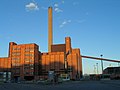 Hanasaari B
 -
 Trigeneration Cycle
 -
 Power plant at sunset
 -
 Mirant Kendall Cogeneration Station


