Chromatic aberration: Difference between revisions
CSV import Tags: mobile edit mobile web edit |
CSV import |
||
| Line 36: | Line 36: | ||
[[Category:Physics]] | [[Category:Physics]] | ||
{{Optics-stub}} | {{Optics-stub}} | ||
== Chromatic_aberration == | |||
<gallery> | |||
File:Chromatic_aberration_lens_diagram.svg|Diagram showing chromatic aberration in a lens | |||
File:Chromatic_aberration_(comparison).jpg|Comparison of images with and without chromatic aberration | |||
File:Comparison_chromatic_focus_shift_plots.svg|Plots comparing chromatic focus shift | |||
File:Chromatic_aberration_lens_diagram.svg|Diagram showing chromatic aberration in a lens | |||
File:diffractive.png|Chromatic_aberration | |||
File:Lens6b-en.svg|Diagram of lens showing chromatic aberration | |||
File:Filigranski_nakit_02_edit.JPG|Chromatic_aberration | |||
</gallery> | |||
Latest revision as of 11:19, 18 February 2025
Chromatic Aberration is a type of distortion in optical systems that results in the inability to focus all colors to the same convergence point. It is caused by lens dispersion, with different colors of light travelling at different speeds while passing through a lens. This causes the colors to refract at different angles, resulting in the phenomenon of chromatic aberration.
Causes[edit]
Chromatic aberration is primarily caused by lens dispersion, a property of light in which different colors (or wavelengths) of light travel at different speeds when passing through a lens. This difference in speed causes the light to bend, or refract, at different angles, leading to the colors not converging at the same point after passing through the lens.
Types[edit]
There are two types of chromatic aberration: longitudinal chromatic aberration (also known as axial chromatic aberration) and lateral chromatic aberration (also known as transverse chromatic aberration).
Longitudinal Chromatic Aberration[edit]
Longitudinal chromatic aberration occurs when different wavelengths of light converge at different distances from the lens. This results in a colored fringe along the boundaries that separate dark and bright parts of the image, because each color in the optical spectrum cannot be focused at a single common point on the optical axis.
Lateral Chromatic Aberration[edit]
Lateral chromatic aberration occurs when different wavelengths of light are focused at different positions in the focal plane because the magnification and hence the position of the focus of each color of light is different from the others.
Correction[edit]
Chromatic aberration can be minimized through the use of achromatic lenses or apochromatic lenses. These lenses are designed to correct chromatic aberration at certain wavelengths.
In Photography[edit]
In photography, chromatic aberration can cause colored fringes in high-contrast areas of the image. Many modern digital cameras and image editing software include features to minimize or eliminate the appearance of these fringes.
See Also[edit]

Chromatic_aberration[edit]
-
 Diagram showing chromatic aberration in a lens
 -
 Comparison of images with and without chromatic aberration
 -
 Plots comparing chromatic focus shift
 -
Diagram showing chromatic aberration in a lens
-
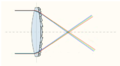 Chromatic_aberration
 -
 Diagram of lens showing chromatic aberration
 -
 Chromatic_aberration

.jpg)


