Achromatic lens
Achromatic lens
An achromatic lens is a type of lens designed to limit the effects of chromatic aberration, which is the failure of a lens to focus all colors to the same point. Achromatic lenses are corrected to bring two wavelengths, typically red and blue, into focus in the same plane. This is achieved by combining two types of glass with different dispersion properties.
Design and Function[edit]
Achromatic lenses are typically made by combining a convex lens made of crown glass with a concave lens made of flint glass. The crown glass lens has a lower dispersion, while the flint glass lens has a higher dispersion. By carefully selecting the radii of curvature and the types of glass, the lens maker can ensure that two wavelengths of light are brought to the same focus, thus minimizing chromatic aberration.
The most common type of achromatic lens is the achromatic doublet, which consists of two individual lenses cemented together. The doublet is designed such that the chromatic aberration of one lens is counteracted by the chromatic aberration of the other.
Applications[edit]
Achromatic lenses are widely used in optical instruments such as microscopes, telescopes, and cameras. They are essential in applications where high-quality image formation is required, as they significantly reduce the color fringing that can occur with simple lenses.
Limitations[edit]
While achromatic lenses correct for two wavelengths, they do not completely eliminate chromatic aberration. There is still some residual chromatic aberration, known as the "secondary spectrum," which can be further reduced by using apochromatic lenses, which bring three wavelengths into focus.
Gallery[edit]
-
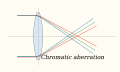 Diagram showing chromatic aberration in a simple lens.
 -
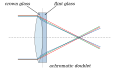 Illustration of an achromatic doublet lens.
 -
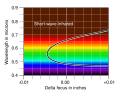 Graph showing the focal curve of an achromatic lens.


Related pages[edit]
Achromatic_lens[edit]

Medical Disclaimer: WikiMD is for informational purposes only and is not a substitute for professional medical advice. Content may be inaccurate or outdated and should not be used for diagnosis or treatment. Always consult your healthcare provider for medical decisions. Verify information with trusted sources such as CDC.gov and NIH.gov. By using this site, you agree that WikiMD is not liable for any outcomes related to its content. See full disclaimer.
Credits:Most images are courtesy of Wikimedia commons, and templates, categories Wikipedia, licensed under CC BY SA or similar.
Translate page: - East Asian
中文,
日本,
한국어,
South Asian
हिन्दी,
தமிழ்,
తెలుగు,
Urdu,
ಕನ್ನಡ,
Southeast Asian
Indonesian,
Vietnamese,
Thai,
မြန်မာဘာသာ,
বাংলা
European
español,
Deutsch,
français,
Greek,
português do Brasil,
polski,
română,
русский,
Nederlands,
norsk,
svenska,
suomi,
Italian
Middle Eastern & African
عربى,
Turkish,
Persian,
Hebrew,
Afrikaans,
isiZulu,
Kiswahili,
Other
Bulgarian,
Hungarian,
Czech,
Swedish,
മലയാളം,
मराठी,
ਪੰਜਾਬੀ,
ગુજરાતી,
Portuguese,
Ukrainian

