Basilar membrane: Difference between revisions
CSV import |
CSV import |
||
| Line 30: | Line 30: | ||
[[Category:Auditory system]] | [[Category:Auditory system]] | ||
{{anatomy-stub}} | {{anatomy-stub}} | ||
== Basilar_membrane == | |||
<gallery> | |||
File:Cochlea-crosssection.svg|Cochlea cross-section | |||
File:Organ_of_corti_flipped.png|Organ of Corti flipped | |||
File:Gray928.png|Gray's Anatomy Plate 928 | |||
File:Gray929.png|Gray's Anatomy Plate 929 | |||
File:Gray930.png|Gray's Anatomy Plate 930 | |||
File:Gray931.png|Gray's Anatomy Plate 931 | |||
File:Gray932.png|Gray's Anatomy Plate 932 | |||
</gallery> | |||
Latest revision as of 21:20, 23 February 2025
Basilar Membrane
The basilar membrane is a crucial structure in the inner ear that plays a significant role in the mechanism of hearing. It is a part of the cochlea, a spiral-shaped organ that is responsible for converting sound vibrations into neural signals.
Structure[edit]
The basilar membrane is a thin, elongated structure that stretches the entire length of the cochlea. It is composed of a stiff, fibrous matrix that provides structural support. The width and stiffness of the basilar membrane vary along its length, with the base being narrower and stiffer than the apex. This variation in physical properties allows the membrane to respond differently to different frequencies of sound.
Function[edit]
The primary function of the basilar membrane is to separate two of the cochlea's fluid-filled compartments, the scala tympani and the scala media. When sound waves enter the cochlea, they cause the fluid in these compartments to move, which in turn causes the basilar membrane to vibrate. These vibrations are detected by the organ of Corti, a structure located on the surface of the basilar membrane, which contains the sensory hair cells that convert the mechanical vibrations into electrical signals. These signals are then transmitted to the brain via the auditory nerve, resulting in the perception of sound.
Clinical Significance[edit]
Damage or abnormalities in the basilar membrane can lead to various hearing disorders. For instance, presbycusis, or age-related hearing loss, is often associated with degeneration of the basilar membrane. Similarly, exposure to loud noises can cause mechanical damage to the basilar membrane, leading to noise-induced hearing loss.
See Also[edit]
References[edit]

Basilar_membrane[edit]
-
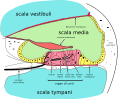 Cochlea cross-section
 -
 Organ of Corti flipped
 -
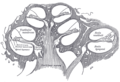 Gray's Anatomy Plate 928
 -
 Gray's Anatomy Plate 929
 -
 Gray's Anatomy Plate 930
 -
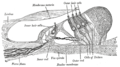 Gray's Anatomy Plate 931
 -
 Gray's Anatomy Plate 932


