Satay: Difference between revisions
CSV import Tags: mobile edit mobile web edit |
CSV import |
||
| Line 29: | Line 29: | ||
[[Category:Street food]] | [[Category:Street food]] | ||
{{Food-stub}} | {{Food-stub}} | ||
<gallery> | |||
File:Sate Ponorogo.jpg|Sate Ponorogo | |||
File:COLLECTIE TROPENMUSEUM Studioportret van een verkoper van saté met zijn pikolan en klanten TMnr 60027242.jpg|Satay Seller with Customers | |||
File:Raw satay.JPG|Raw Satay | |||
File:Sate Babi and Karedok in Ubud 3.jpg|Sate Babi and Karedok in Ubud | |||
File:COLLECTIE TROPENMUSEUM Model van een sate-verkoper TMnr 2197-3.jpg|Model of a Satay Seller | |||
File:Satay Seller Java.jpg|Satay Seller in Java | |||
File:National Museum of Ethnology, Osaka - Cart of Satay - Jakarta, Indonesia.jpg|Cart of Satay - Jakarta, Indonesia | |||
File:Sate Ponorogo Stall.jpg|Sate Ponorogo Stall | |||
File:Sate-2.JPG|Sate | |||
File:Sate ayam-Jakarta.JPG|Sate Ayam Jakarta | |||
File:Sate taichan jakarta.jpg|Sate Taichan Jakarta | |||
File:Sate Buntel Solo Grilling.JPG|Sate Buntel Solo Grilling | |||
</gallery> | |||
Latest revision as of 01:45, 20 February 2025
Satay is a popular dish in Southeast Asia, particularly in Indonesia, Malaysia, and Thailand. It consists of skewered, grilled meat served with a sauce, often a variant of peanut sauce. The meat can be marinated in a variety of spices depending on the recipe, but turmeric is a common ingredient, giving the dish its characteristic yellow color.
History[edit]
The origin of satay is unclear, with various theories suggesting it could have been influenced by Indian cuisine, Arabic cuisine, or the Chinese kebab. However, it is most commonly associated with Indonesia, where it is considered a national dish.
Preparation[edit]
Satay is traditionally made with chicken, beef, or mutton, but can also be made with other types of meat, including fish, tofu, or vegetables. The meat is first marinated in a mixture of spices and then skewered onto bamboo sticks. It is then grilled over a wood or charcoal fire until it is cooked. The dish is typically served with a dipping sauce, the most common of which is a spicy peanut sauce.
Varieties[edit]
There are many regional variations of satay, each with its own unique flavor profile. For example, Satay Padang from West Sumatra is made with beef, while Satay Lilit from Bali is made with minced fish. In Malaysia, Satay Kajang is a popular variant that is larger and served with a thicker peanut sauce. In Thailand, satay is often served with a sweet and sour cucumber salad.
Cultural Significance[edit]
Satay is often served at celebrations and festivals in Southeast Asia. It is also a popular street food, with vendors selling it at markets and roadside stalls. In Indonesia, the dish is so beloved that a satay museum has been established in Jakarta.
See Also[edit]

-
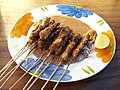 Sate Ponorogo
 -
 Satay Seller with Customers
 -
 Raw Satay
 -
 Sate Babi and Karedok in Ubud
 -
 Model of a Satay Seller
 -
Satay Seller in Java
-
Cart of Satay - Jakarta, Indonesia
-
Sate Ponorogo Stall
-
Sate
-
Sate Ayam Jakarta
-
Sate Taichan Jakarta
-
Sate Buntel Solo Grilling


