Korea: Difference between revisions
CSV import Tags: mobile edit mobile web edit |
CSV import |
||
| Line 23: | Line 23: | ||
[[Category:Regions of Asia]] | [[Category:Regions of Asia]] | ||
{{Asia-stub}} | {{Asia-stub}} | ||
<gallery> | |||
File:Unification_flag_of_Korea.svg|Korea | |||
File:Flag_of_South_Korea.svg|Flag of South Korea | |||
File:Flag_of_North_Korea.svg|Flag of North Korea | |||
File:7th_century_painting_of_Koreans.png|7th century painting of Koreans | |||
File:Seokguram_Buddha.JPG|Seokguram Buddha | |||
File:Three_Kingdoms_of_Korea_Map.png|Three Kingdoms of Korea Map | |||
File:Unified_Silla_and_Balhae_(8th_Century)_(4261052261).jpg|Unified Silla and Balhae (8th Century) | |||
File:History_of_Korea-1374.png|History of Korea 1374 | |||
File:경복궁_전경.jpg|경복궁 전경 | |||
File:Donggwol-do.jpg|Donggwol-do | |||
File:남산_정상에서_바라본_서울_풍경_(1884).jpg|남산 정상에서 바라본 서울 풍경 (1884) | |||
File:Flag_of_Korea_1882.svg|Flag of Korea 1882 | |||
</gallery> | |||
Latest revision as of 12:23, 18 February 2025
Korea is a region in East Asia. Since 1945, it has been divided into two distinct sovereign states: North Korea (officially the "Democratic People's Republic of Korea") and South Korea (officially the "Republic of Korea"). Korea consists of the Korean Peninsula, Jeju Island, and several minor islands near the peninsula. It is bordered by China to the northwest and Russia to the northeast.
History[edit]
Korea's history begins with the founding of Gojoseon in 2333 BC by the legendary Dangun. Following the unification of the Three Kingdoms of Korea under Silla in 676, Korea was subsequently ruled by the Goryeo dynasty (918–1392) and the Joseon dynasty (1392–1910). It was annexed by the Empire of Japan in 1910. At the end of World War II, Korea was divided into Soviet and U.S. zones of occupations. An election was held in the U.S. zone in 1948 which led to the creation of the Republic of Korea. The Soviet zone became the Democratic People's Republic of Korea.
Culture[edit]
Korean culture has evolved greatly from its beginnings. Contemporary culture combines influences from the traditional Korean culture, and from the cultures of neighboring countries, and the Western world. Traditional Korean arts include crafts such as pottery, textiles, woodwork, and lacquerware. Korean music, dance, painting, and sculpture, rank with the highest classical arts.
Cuisine[edit]
Korean cuisine, hailing from ancient agricultural and nomadic traditions in southern Manchuria and the Korean peninsula, has evolved through a complex interaction of the natural environment and different cultural trends. It is largely based on rice, vegetables, and meats. Traditional Korean meals are noted for the number of side dishes that accompany steam-cooked short-grain rice.
Economy[edit]
South Korea is known for its spectacular rise from one of the poorest countries in the world to a developed, high-income country in just a few generations. This economic growth has been described as the Miracle on the Han River. North Korea, on the other hand, has a centrally planned economy where the government makes all economic decisions.
See also[edit]
-
 Korea
Korea -
 Flag of South Korea
 -
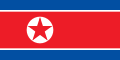 Flag of North Korea
 -
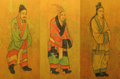 7th century painting of Koreans
 -
Seokguram Buddha
-
Three Kingdoms of Korea Map
-
Unified Silla and Balhae (8th Century)
-
History of Korea 1374
-
경복궁 전경
-
Donggwol-do
-
남산 정상에서 바라본 서울 풍경 (1884)
-
Flag of Korea 1882


_(4261052261).jpg)


.jpg)
.svg)