Science fiction: Difference between revisions
CSV import |
CSV import |
||
| Line 24: | Line 24: | ||
{{Speculative fiction}} | {{Speculative fiction}} | ||
{{Literature-stub}} | {{Literature-stub}} | ||
<gallery> | |||
File:Imagination cover December 1952.jpg|Imagination cover December 1952 | |||
File:Bacon 1628 New Atlantis title page wpreview.png|Bacon 1628 New Atlantis title page | |||
File:The War of the Worlds by Henrique Alvim Corrêa, original graphic 15.jpg|The War of the Worlds by Henrique Alvim Corrêa, original graphic | |||
File:Maria from the film Metropolis, on display at the Robot Hall of Fame.jpg|Maria from the film Metropolis, on display at the Robot Hall of Fame | |||
File:Al Hodge Don Hastings Captain Video.JPG|Al Hodge Don Hastings Captain Video | |||
File:Imagination 195808.jpg|Imagination August 1958 | |||
File:Feliz 1984.JPG|Feliz 1984 | |||
File:William Strang spider battle in 1894 True History.jpg|William Strang spider battle in 1894 True History | |||
File:Victoria Building, University of Liverpool 2019.jpg|Victoria Building, University of Liverpool 2019 | |||
File:Frontispiece to Frankenstein 1831.jpg|Frontispiece to Frankenstein 1831 | |||
</gallery> | |||
Latest revision as of 05:50, 3 March 2025
Science fiction is a genre of speculative fiction that typically deals with imaginative and futuristic concepts such as advanced science and technology, space exploration, time travel, parallel universes, and extraterrestrial life. It has been called the "literature of ideas", and often explores the potential consequences of scientific, social, and technological innovations.
History[edit]
Science fiction has its origins in the age of the Enlightenment, which saw the rise of a new interest in science among the public. Works of science fiction began to appear during the 19th century and grew in popularity throughout the 20th century. The genre has become a staple of popular culture, influencing every medium from books and films to video games and television shows.
Sub-genres[edit]
Science fiction encompasses a wide range of sub-genres, each with its own unique characteristics and themes. These include hard science fiction, which emphasizes scientific accuracy and detail; soft science fiction, which is more focused on character and speculative societies and cultures; cyberpunk, which deals with issues related to artificial intelligence and cybernetics; and space opera, which is characterized by epic, sweeping tales of adventure and conflict in outer space.
Themes[edit]
Common themes in science fiction include the exploration of space, time travel, and life on other planets. The genre often explores the potential consequences of scientific and technological innovations, and how these may impact or transform societies. Other recurring themes include artificial intelligence, dystopian futures, and post-apocalyptic worlds.
Influence[edit]
Science fiction has had a significant influence on modern society, particularly in the realm of technology. Many of the technologies we take for granted today were first envisioned in science fiction, from cell phones to virtual reality. The genre has also influenced the fields of philosophy, ethics, and social science.
See also[edit]
- List of science fiction authors
- List of science fiction novels
- List of science fiction films
- List of science fiction television shows
| Speculative fiction | ||||||||
|---|---|---|---|---|---|---|---|---|
|

This article is a literature-related stub. You can help WikiMD by expanding it!
-
 Imagination cover December 1952
 -
 Bacon 1628 New Atlantis title page
 -
 The War of the Worlds by Henrique Alvim Corrêa, original graphic
 -
 Maria from the film Metropolis, on display at the Robot Hall of Fame
 -
 Al Hodge Don Hastings Captain Video
 -
 Imagination August 1958
 -
 Feliz 1984
 -
 William Strang spider battle in 1894 True History
 -
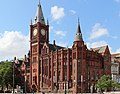 Victoria Building, University of Liverpool 2019
 -
 Frontispiece to Frankenstein 1831


