Membrane transport protein: Difference between revisions
CSV import |
CSV import |
||
| Line 36: | Line 36: | ||
{{cell-bio-stub}} | {{cell-bio-stub}} | ||
{{protein-stub}} | {{protein-stub}} | ||
<gallery> | |||
File:Scheme_sodium-potassium_pump-en.svg|Sodium-potassium pump mechanism | |||
File:Scheme_facilitated_diffusion_in_cell_membrane-en.svg|Facilitated diffusion in cell membrane | |||
File:Screenshot_2023-11-21_at_7.24.28_PM.png|Membrane_transport_protein | |||
File:Symport.png|Symport mechanism | |||
File:Uniport.png|Uniport mechanism | |||
File:Antiport.png|Antiport mechanism | |||
File:Screenshot_2023-11-21_at_10.00.03_PM.png|Membrane_transport_protein | |||
File:Screenshot_2023-11-21_at_10.00.46_PM.png|Membrane_transport_protein | |||
</gallery> | |||
Revision as of 11:41, 18 February 2025
Membrane transport protein is a type of protein that facilitates the movement of substances across a biological membrane. These proteins are integral to the function of cells, as they allow for the selective transport of specific molecules, such as ions, small molecules, and macromolecules, across the cell membrane. This process is essential for maintaining the balance of various substances within the cell and for the cell's overall survival.
Types of Membrane Transport Proteins
There are several types of membrane transport proteins, each with a specific function. These include:
- Channel proteins: These proteins form a channel that allows specific molecules or ions to pass through the membrane.
- Carrier proteins: These proteins bind to a specific molecule or ion and change shape to transport the molecule across the membrane.
- ATP-powered pumps: These proteins use the energy from ATP hydrolysis to transport specific ions or molecules across the membrane.
- Light-driven pumps: These proteins, found mainly in photosynthetic bacteria, use energy derived from light to transport ions across the membrane.
Function of Membrane Transport Proteins
Membrane transport proteins play a crucial role in maintaining the homeostasis of the cell. They regulate the movement of substances in and out of the cell, ensuring that the cell maintains the right balance of nutrients, ions, and water. This is essential for the cell's survival and function.
In addition, membrane transport proteins are involved in signal transduction, allowing cells to respond to changes in their environment. They also play a role in cell adhesion, helping cells stick together and interact with their surroundings.
Diseases Associated with Membrane Transport Proteins
Defects in membrane transport proteins can lead to a variety of diseases. For example, mutations in the CFTR protein, a type of ATP-powered pump, can lead to cystic fibrosis, a disease characterized by the buildup of thick, sticky mucus in the lungs and other organs. Similarly, defects in various ion channels can lead to diseases such as epilepsy, long QT syndrome, and cystinuria.
See Also
This cell biology related article is a stub. You can help WikiMD by expanding it.

-
 Sodium-potassium pump mechanism
 -
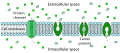 Facilitated diffusion in cell membrane
 -
Membrane_transport_protein
-
 Symport mechanism
 -
 Uniport mechanism
 -
 Antiport mechanism
 -
Membrane_transport_protein
-
Membrane_transport_protein


