Trebbiano: Difference between revisions
CSV import Tags: mobile edit mobile web edit |
CSV import |
||
| Line 1: | Line 1: | ||
{{short description|Variety of grape}} | |||
{{Use dmy dates|date=October 2023}} | |||
'''Trebbiano''', also known as '''Ugni blanc''', is a white [[grape]] variety that is one of the most widely planted in the world. It is known for its high yields and its ability to produce wines with a fresh, fruity character. Trebbiano is used in the production of both [[wine]] and [[brandy]], including the famous [[Cognac]] and [[Armagnac]] in [[France]]. | |||
The origins of Trebbiano are | ==History== | ||
The origins of Trebbiano are believed to date back to [[Roman Empire|Roman times]], with the grape being mentioned in historical texts. It is thought to have originated in the eastern Mediterranean and was brought to Italy by the Romans. Over the centuries, Trebbiano spread throughout [[Italy]] and into other parts of Europe, including [[France]], where it is known as Ugni blanc. | |||
== | ==Viticulture== | ||
Trebbiano is a vigorous vine that produces large clusters of grapes. It is adaptable to a variety of climates and soil types, which contributes to its widespread cultivation. The grape is known for its high acidity and neutral flavor profile, making it suitable for blending with other grape varieties. Trebbiano is often used in the production of [[white wine]]s, where it contributes freshness and acidity. | |||
Trebbiano | ==Wine regions== | ||
Trebbiano is grown in several wine regions around the world. In Italy, it is found in regions such as [[Tuscany]], [[Emilia-Romagna]], and [[Lazio]]. In France, Ugni blanc is primarily grown in the [[Cognac]] and [[Armagnac]] regions, where it is used to produce brandy. The grape is also cultivated in other countries, including [[Australia]], [[Argentina]], and the [[United States]]. | |||
== | ==Wine styles== | ||
Trebbiano wines are typically light-bodied with a crisp, refreshing acidity. They often exhibit flavors of citrus, green apple, and pear. The grape's neutral character makes it a good candidate for blending, and it is often used in the production of [[blended wine]]s. In addition to still wines, Trebbiano is used to produce [[sparkling wine]]s and [[fortified wine]]s. | |||
==Related pages== | |||
* [[Wine]] | |||
* [[Grape]] | |||
* [[Cognac]] | |||
* [[Armagnac]] | |||
== | ==Gallery== | ||
<gallery> | |||
File:Ugni_blanc_Viala_et_Vermorel.jpg|Illustration of Ugni blanc from Viala et Vermorel | |||
File:Ugni_blanc_raisin.jpg|Bunch of Ugni blanc grapes | |||
File:Trebbiano-Uva_bianca_per_Vino_Falerio_delle_Marche.jpg|Trebbiano grapes used for Falerio dei Colli Ascolani wine | |||
</gallery> | |||
==References== | |||
{{Reflist}} | |||
[[Category:White wine grape varieties]] | |||
[[Category:Wine grapes of Italy]] | |||
[[Category:Wine grapes of France]] | |||
[[Category: | |||
[[Category: | |||
[[Category: | |||
Revision as of 00:00, 10 February 2025
Variety of grape
Trebbiano, also known as Ugni blanc, is a white grape variety that is one of the most widely planted in the world. It is known for its high yields and its ability to produce wines with a fresh, fruity character. Trebbiano is used in the production of both wine and brandy, including the famous Cognac and Armagnac in France.
History
The origins of Trebbiano are believed to date back to Roman times, with the grape being mentioned in historical texts. It is thought to have originated in the eastern Mediterranean and was brought to Italy by the Romans. Over the centuries, Trebbiano spread throughout Italy and into other parts of Europe, including France, where it is known as Ugni blanc.
Viticulture
Trebbiano is a vigorous vine that produces large clusters of grapes. It is adaptable to a variety of climates and soil types, which contributes to its widespread cultivation. The grape is known for its high acidity and neutral flavor profile, making it suitable for blending with other grape varieties. Trebbiano is often used in the production of white wines, where it contributes freshness and acidity.
Wine regions
Trebbiano is grown in several wine regions around the world. In Italy, it is found in regions such as Tuscany, Emilia-Romagna, and Lazio. In France, Ugni blanc is primarily grown in the Cognac and Armagnac regions, where it is used to produce brandy. The grape is also cultivated in other countries, including Australia, Argentina, and the United States.
Wine styles
Trebbiano wines are typically light-bodied with a crisp, refreshing acidity. They often exhibit flavors of citrus, green apple, and pear. The grape's neutral character makes it a good candidate for blending, and it is often used in the production of blended wines. In addition to still wines, Trebbiano is used to produce sparkling wines and fortified wines.
Related pages
Gallery
-
 Illustration of Ugni blanc from Viala et Vermorel
 -
 Bunch of Ugni blanc grapes
 -
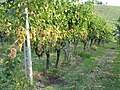 Trebbiano grapes used for Falerio dei Colli Ascolani wine


References
<references group="" responsive="1"></references>
