Saeu-jeot: Difference between revisions
CSV import Tags: mobile edit mobile web edit |
CSV import |
||
| Line 21: | Line 21: | ||
{{Korea-food-stub}} | {{Korea-food-stub}} | ||
{{food-stub}} | {{food-stub}} | ||
== Saeu-jeot == | |||
<gallery> | |||
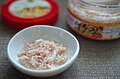
File:Saeujeot (fermented shrimp) jeotgal (Caridea) 3.jpg|Saeu-jeot | |||
</gallery> | |||
Latest revision as of 01:41, 20 February 2025
Saeu-jeot is a traditional Korean fermented food product made from salted shrimp. It is a type of jeotgal, a category of salted and fermented dishes in Korean cuisine. Saeu-jeot is widely used as a seasoning and a condiment in various Korean dishes, such as kimchi, soups, and stews.
History[edit]
The history of saeu-jeot dates back to the Three Kingdoms period (57 BC – 668 AD). The method of making saeu-jeot was recorded in the Samguk Sagi, a historical record of the Three Kingdoms of Korea.
Preparation[edit]
Saeu-jeot is prepared by fermenting salted shrimp. The shrimp used in saeu-jeot are small, about 1 cm long. The shrimp are mixed with salt, usually in a ratio of about 2:1 by weight. The mixture is then fermented in a jangdok, a traditional Korean earthenware crock, for several months. The fermentation process produces a salty, flavorful liquid, which is the saeu-jeot.
Culinary uses[edit]
Saeu-jeot is a key ingredient in many Korean dishes. It is used as a seasoning in kimchi, adding a depth of flavor to the fermented vegetable dish. It is also used in various soups and stews, such as doenjang jjigae, a fermented soybean paste stew, and sundubu jjigae, a soft tofu stew. In addition, saeu-jeot can be used as a dipping sauce for grilled meats and vegetables.
See also[edit]

Saeu-jeot[edit]
-
 Saeu-jeot
_jeotgal_(Caridea)_3.jpg)
