Chasselas: Difference between revisions
CSV import Tags: mobile edit mobile web edit |
CSV import |
||
| Line 34: | Line 34: | ||
{{wine-stub}} | {{wine-stub}} | ||
{{food-stub}} | {{food-stub}} | ||
<gallery> | |||
File:Weintrauben.Weiss.jpg|Chasselas | |||
File:Roter_Gutedel_Weinsberg_20060909.jpg|Chasselas | |||
File:Gro__e_Crvena_plemenka.jpg|Chasselas | |||
</gallery> | |||
Revision as of 01:42, 18 February 2025
Chasselas or Chasselas blanc is a wine grape variety grown in Switzerland, France, Germany, Portugal, Hungary, Romania and New Zealand. Chasselas is mostly vinified to be a full, dry and fruity white wine. It is also suitable as a table grape, grown widely for this purpose in Turkey and Hungary.
History
The origins of Chasselas are believed to be in the Lake Geneva region of Switzerland. The variety is known to have been grown in the canton of Vaud by the 17th century and spread from there to other parts of the country.
Viticulture
Chasselas is an early-ripening grape variety. The vine has robust growth and is resistant to fungal diseases, but can be susceptible to botrytis due to its compact bunches. It is used in viticulture as a benchmark for early ripening periods.
Wine regions
In Switzerland, Chasselas is grown in all wine regions, being most prevalent in Vaud, Valais and Geneva. In France, it is mostly grown in the Loire Valley and in the Alsace region. In Germany, it is grown in the Baden region under the name Gutedel. In New Zealand, it is mainly found in the North Island region.
Wines
Chasselas wines are said to have an "earthly" flavor, often with notes of green apple and citrus. They are generally dry and light-bodied.
Food pairing
Chasselas wines are versatile and can be paired with a variety of dishes. They are particularly good with Swiss cuisine, such as fondue and raclette.
See also


-
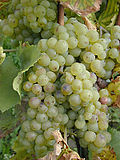 Chasselas
 -
 Chasselas
 -
Chasselas


