Cabernet Franc: Difference between revisions
CSV import |
CSV import |
||
| Line 32: | Line 32: | ||
{{wine-stub}} | {{wine-stub}} | ||
{{food-stub}} | {{food-stub}} | ||
==Cabernet Franc== | |||
<gallery> | |||
File:Cab_Franc_grape.JPG|Cabernet Franc grapes | |||
File:Cab_franc_leaf.JPG|Cabernet Franc leaf | |||
File:Cheval_blanc_1995.jpg|Cheval Blanc 1995 | |||
File:Cabernet_Franc_Weinsberg_20060909.jpg|Cabernet Franc Weinsberg | |||
File:Washington_cab_franc.jpg|Washington Cabernet Franc | |||
File:Cabernet_Franc_from_Red_Willow_vineyard.jpg|Cabernet Franc from Red Willow vineyard | |||
File:Chinon_wine,_bottle,_cork,_foil_and_corkscrew.jpg|Chinon wine, bottle, cork, foil, and corkscrew | |||
</gallery> | |||
Revision as of 11:12, 18 February 2025
Cabernet Franc is a black-skinned French grape variety grown in most wine producing regions worldwide. It is one of the major black grape varieties worldwide. It is principally grown for blending with Cabernet Sauvignon and Merlot in the Bordeaux style, but can also be vinified alone, as in the Loire's Chinon. In addition to being used in blends and produced as a varietal in Canada and the United States, it is sometimes made into ice wine in those regions.
Cabernet Franc is lighter than Cabernet Sauvignon, making a bright pale red wine that contributes finesse and lends a peppery perfume to blends with more robust grapes. Depending on the growing region and style of wine, additional aromas can include tobacco, raspberry, bell pepper, cassis, and violets.
Records of Cabernet Franc in Bordeaux go back to the end of the 18th century, although it was planted in Loire long before that time. DNA analysis indicates that Cabernet Franc is one of two parents of Cabernet Sauvignon, Merlot, and Carménère.
History
The origins of Cabernet Franc are unclear, but ampelographers believe it may have originated in Basque country. It was planted in the Loire Valley and Bordeaux by the 17th century.
In the 19th century, plantings of Cabernet Franc were found throughout Bordeaux. Today, it is less commonly grown in Bordeaux, where the climate and soil is more suited to the more late-ripening Cabernet Sauvignon.
Viticulture
Cabernet Franc is a relatively versatile grape, able to adapt to a variety of vineyard soil types. It is a vigorous vine that buds early and ripens early, making it susceptible to the viticultural hazards of frost in the spring and harvest rains in the fall. The vine is also prone to mutation, with different clones of Cabernet Franc found throughout the wine regions of the world.
Wine regions
Cabernet Franc is planted throughout the world in a variety of wine regions. In France, it is found predominately in the Loire Valley and Bordeaux. It is also found in Italy, Spain, Australia, New Zealand, Canada, and the United States.
Styles
The style of Cabernet Franc wine can vary widely depending on the region and the winemaking techniques used. In general, it is lighter in body and lower in tannins than Cabernet Sauvignon. It often shows a bright red fruit character with a distinct peppery or spicy component.
Food pairing
Cabernet Franc is a versatile wine for food pairing, working well with a variety of meats, poultry, and game. It is also a good match for tomato-based dishes and a variety of cheeses.


Cabernet Franc
-
 Cabernet Franc grapes
 -
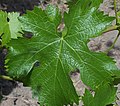 Cabernet Franc leaf
 -
 Cheval Blanc 1995
 -
 Cabernet Franc Weinsberg
 -
 Washington Cabernet Franc
 -
 Cabernet Franc from Red Willow vineyard
 -
 Chinon wine, bottle, cork, foil, and corkscrew


