Schupfnudel: Difference between revisions
CSV import |
CSV import |
||
| Line 30: | Line 30: | ||
{{German-cuisine-stub}} | {{German-cuisine-stub}} | ||
{{food-stub}} | {{food-stub}} | ||
== Schupfnudel == | |||
<gallery> | |||
File:Schupfnudeln mit Sauerkraut.jpg|Schupfnudeln with Sauerkraut | |||
File:Nudli (mákos) 2.jpg|Nudli (mákos) | |||
</gallery> | |||
Latest revision as of 01:08, 20 February 2025
Schupfnudel is a type of German dumpling or noodle that is similar to the Italian gnocchi. The name "Schupfnudel" is derived from the German verb "schupfen," meaning "to push, thrust, or toss."
History[edit]
The origins of Schupfnudel are believed to be in the Baden-Württemberg region of Germany, where they are still a popular dish today. However, variations of Schupfnudel can be found throughout Germany and in parts of Austria and Switzerland.
Preparation[edit]
Schupfnudel is typically made from a mixture of potatoes, flour, and eggs. The dough is rolled out into long, thin ropes and then cut into small pieces. These pieces are then shaped into the characteristic "finger" or "noodle" shape of the Schupfnudel.
The Schupfnudel can be boiled or fried, depending on personal preference. They are often served with sauerkraut, bacon, or onions, but can also be served with a variety of other accompaniments, such as cheese, mushrooms, or meat.
Variations[edit]
There are many variations of Schupfnudel, including those made with rye flour or buckwheat flour, and those that are filled with meat, cheese, or fruit. Some variations are also sweet, rather than savory, and are served as a dessert.
Cultural Significance[edit]
Schupfnudel is a traditional dish in many parts of Germany, particularly in the south. It is often served at Oktoberfest and other festivals, and is a popular comfort food during the cold winter months.
See Also[edit]
This article is a German cuisine stub. You can help WikiMD by expanding it!

Schupfnudel[edit]
-
 Schupfnudeln with Sauerkraut
 -
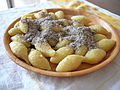 Nudli (mákos)

_2.jpg)
